
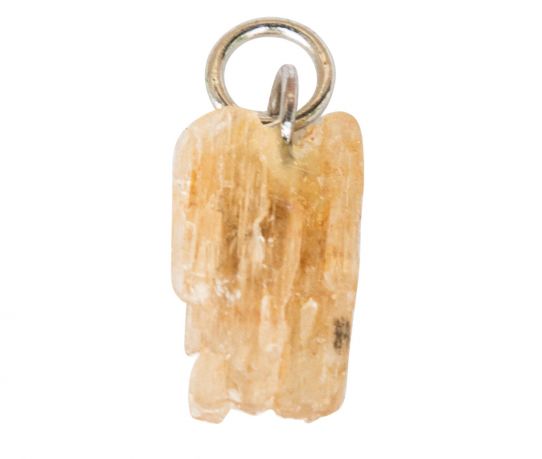
Description
Scapolite is a mineral group in the isomorphic series between Marialite and mejonite. Both belong to the tectosilicates. Transparent to translucent white, gray, yellow, pale brown, or pink scapolite has a vitreous luster, a white streak color, and distinct cleavage along the crystal faces [100] and [110]. Scapolite has an average density of 2.66 and a hardness of 6. The crystal system is tetragonal, and the mineral is not radioactive. The name scapolite is derived from the Greek words skapos ("staff") and lithos, meaning "stone." Scapolite is a mineral that occurs as a weathering product of plagioclases from gabbros. The type locality of scapolite is Otter Lake in Canada. Deposits are found in Myanmar (Mogok), where yellow, pinkish-violet, and blue crystals are found. Some exhibit a cat's-eye effect. Similar scapolites also occur in Sri Lanka (Balangoda in Ratnapura). Yellow scapolites are mined in Canada, light yellow ones in Brazil. Individual transparent crystals can reach 40 x 10 cm. Gemstone scapolites also occur in Tanzania, Kenya, Madagascar, and Mozambique. Large cut stones are rare. The Smithsonian Institution in Washington holds, among others, a 288-carat cut stone, a 29.9-carat cut scapolite cat's eye from Myanmar, and a heavy yellow-orange cut stone from Tanzania. It is also found in Brevik, Norway.


