
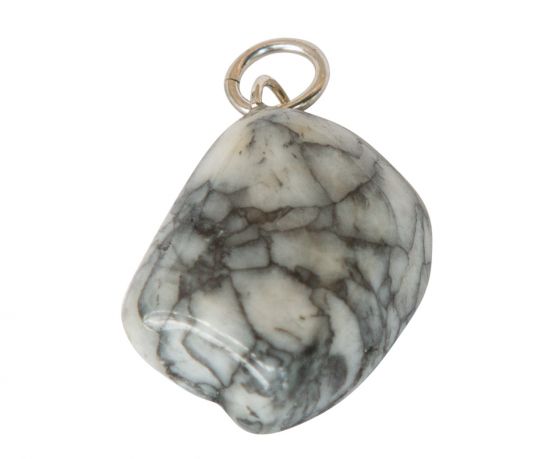
Description
Name for a graphite-pigmented stone, light gray to almost black dolomite with inclusions of white magnesite grains as large as pine nuts (hence the name). Sometimes used as decorative stones.
Magnesite is an ivory-white mineral consisting of magnesium, carbon, and oxygen. The chemical formula of magnesite is MgCO3. Beautiful specimens are difficult to find and are highly sought after by collectors. Magnesite owes its name to its main component, magnesium. Magnesium is an element that occurs frequently in nature. The mineral occurs in solid, opaque, microcrystalline masses that closely resemble porcelain. It has a predominant color, usually grayish or yellowish white. In the case of well-formed crystals, magnesite is colorless and transparent when pure. It is grayish-yellow or yellowish-white, and sometimes no more than translucent when it contains impurities. These are elements such as iron, manganese, or calcium, which partially replace the magnesium in the mineral. In ultraviolet 'light', the crystals exhibit a strong greenish-white or bluish-white fluorescence. Magnesite is often confused with calcite. A reliable identification method is the salt-acid test: if a few drops of dilute acid on the mineral fizz, it is calcite. Iron is an element that often replaces part of the magnesium in magnesite crystals. As a result, the crystal structure of the mineral does not change. Consequently, many possible compositions occur in nature that lie between pure magnesite (magnesium carbonate) and siderite (iron carbonate). As soon as the mineral contains more than 50% iron carbonate, it is considered siderite. In principle, there are three stages: pure magnesite, yellow magnesite, and siderite. Pure magnesite contains colorless, transparent crystals that indicate the mineral contains no iron. Yellow magnesite has a yellow color and indicates a relatively high iron content. Siderite contains an iron content higher than 50% and is therefore no longer considered magnesite. Magnesite forms in various environments. It originates from the transformation of igneous and metamorphic rocks. Generally, it forms massive deposits. The richest deposits of magnesite are located in Spain. Other countries where magnesite is commonly found are Brazil, Italy, Austria, Poland, and Russia.


