


Description
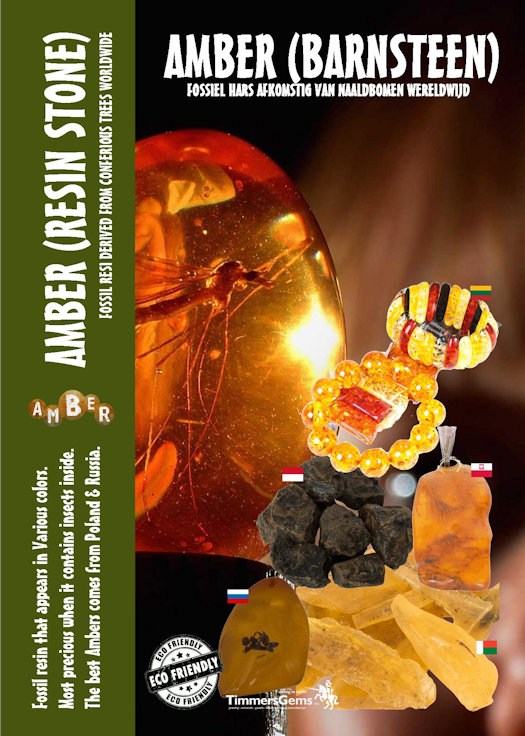
Amber (incorrectly also called amber) is a fossilized resin derived from coniferous trees. These trees were often referred to by the scientific species name Pinus succinifera, a still-living pine species. The resin dripped from the trees millions of years ago and then fossilized. Amber dates from the Mesozoic to the Quaternary. Amber is usually warm yellow to dark red in color, but there are also more green, blue, or even black varieties. Transparent amber is generally considered the most beautiful and the most valuable. Mineralogically speaking, amber has an amorphous structure. It is relatively soft, with a hardness of 2-2.5. The word amber—in German, Bernstein—comes from the Low Saxon word börnen, meaning to burn. Indeed, this semi-precious stone is flammable. Amber is called amber in English. In Dutch, amber usually refers to the color amber. A substance from the intestines of the sperm whale is also called amber. This substance has a strong odor and is used in perfumes. The fact that many insects are found in amber did not escape the notice of the Romans either. They explained this (correctly) by assuming that amber was liquid when it covered the insects. Therefore, they called the stone succinum, or gum-stone. The name still occurs today in succinic acid, in the scientific name for the pine species Pinus succinifera, and also in succinite, a name given by James Dwight Dana to a specific type of amber that comes from the Baltic Sea region. A common group of land snails are the amber snails. They are so named because of the amber-yellow color of their shells. The scientific name of an amber snail species is Succinea putris. Amber becomes electrically charged by rubbing it against animal fur. For this reason, the term "electricity" is derived from the Greek word for amber, elektron (Latin: electrum). In Greek mythology, the god Helios one day allowed his son Phaeton to drive the sun's chariot. But Phaeton couldn't control the horses, causing the sun to scorch heaven and earth. This is how the people of Ethiopia acquired their dark complexion. To save the earth, Zeus threw his thunderbolt at Phaeton, causing him to fall dead. Phaeton's sisters, the Heliades, mourned him. Their tears trickled down and solidified into amber. The Greek mythological figure Electra is identified with amber. The Greek word for amber is "elektron" (ηλεκτρον), from which our word "electricity" derives, because, according to the Greeks, amber came from the amber islands located at the mouth of the legendary amber river in the far north, the Eridanos.


