

Description
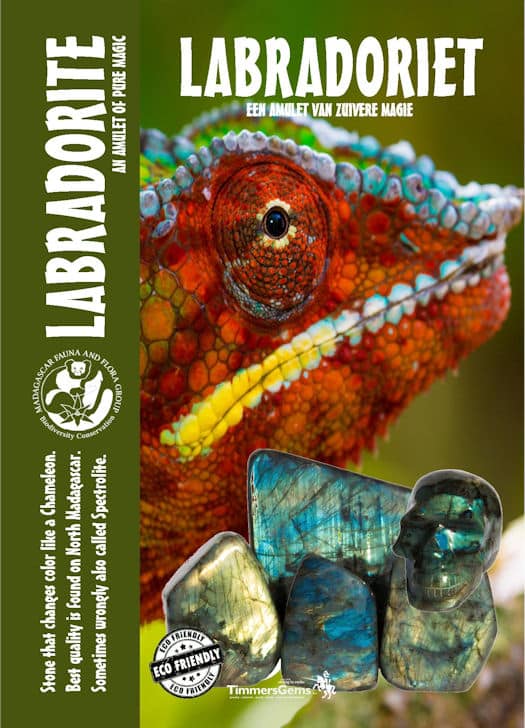
The mineral labradorite is a calcium-sodium-aluminum tectosilicate with the chemical formula (Ca,Na)(Si,Al)4O8. It belongs to the feldspars. Colorless, white, gray, or light green labradorite has a vitreous luster, a white streak color, perfect cleavage along crystal plane [001], and good cleavage along [010]. The average density is 2.69 and the hardness is 7. The crystal system is triclinic, and the mineral is neither radioactive nor magnetic. The characteristic play of colors, called labradorization, is caused by light refracting on microscopic crystals of various dark minerals that lie on the cleavage planes. Labradorite usually occurs amorphous or granular; the mineral rarely, if ever, forms crystals. Of the gemstones that exhibit this play of colors, labradorite is undoubtedly the best-known. When the stone is cut carefully, the play of colors is even more pronounced. But even on the rough fragments, the beautiful labradorization is often visible. Few minerals change color as dramatically as labradorite. The mineral labradorite's name derives from the Labrador Peninsula in Canada, where it was first described. The stone was discovered in 1780 on the east coast of the Labrador Peninsula by a priest and named after the island. He found a large number of boulders with a striking gray color that, when turned, changed to dark blue and green shades. This discovery aroused great interest among scientists of the time, and it was determined that these were soda feldspars, or plagioclase. Labradorite is a common feldspar in metamorphic and igneous rocks such as pegmatite. It is part of the plagioclase series (albite-anorthite). The type locality of labradorite is located on Canada's Labrador Peninsula. Deposits are also found in Australia, Madagascar, Mexico, Russia, the United States and Finland.


