
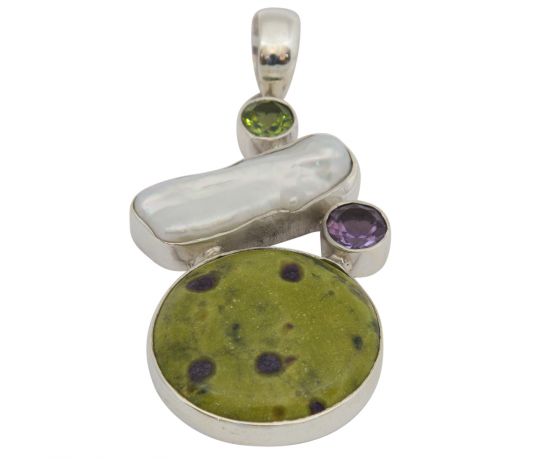
Description
Atlantisite is a combination of serpentine with stichtite.
The mineral serpentine, or clinochrysotile, is a magnesium-iron silicate with the chemical formula (Mg, Fe)3Si2O5(OH)4. It belongs to the phyllosilicate family. This amorphous mineral can be red, yellow, white, and green. The green color is typical of the mineral in the mantle rock serpentinite. Its hardness is 2.5 to 4, depending on the composition, and serpentine has an average density of 2.59. One of these minerals is classified as asbestos. Inhalation of this mineral is harmful to health. The mineral serpentine, like the rock serpentinite, is named after the Latin word serpens, meaning "snake." The shape in which the minerals have grown within the rock is reminiscent of a snake. It was also used in the past as a remedy for snakebites. The other name for serpentinite, clinochrysotile, is derived from the Greek words clinos, chrysos, and tilos ("crooked," "gold," and "fiber," respectively). It is so named because of the gold-colored, fibrous structure the mineral can assume. Serpentine is an indicative mineral for serpentinite, a peridotite often converted by hydrothermal activity. Under the influence of pressure and temperature, olivine and pyroxene from the mantle rock are converted into serpentine. This is sometimes called serpentinitization. The chemical reaction equation is: 4Mg2SiO4 (olivine) + 4H2O(l) + 2CO2(aq) → Mg6Si4O10(OH)8 (serpentine) + MgCO3 (magnesite) Serpentine is therefore a mineral found in areas where mantle rock has reached the surface, usually in orogens. In Greece and the Alps, serpentine is widely exposed.
Stichtite is a purple/pink stone often found in combination with serpentine. A stone with a combination of these two is also called atlantisite. Composition: Mg6Cr2(OH)16-4H2 & hardness: 1.5-2. Stichtite is found in Tasmania, among other places.
Amethyst is a violet variety of the mineral quartz (SiO2) and is the most sought-after stone of the quartz group. Etymology: The name derives from the Greek αμεθυστoς (amethystos). Amethyst was already known to the Egyptians, Etruscans, and Romans, and Pliny the Elder described it. In ancient China, small gems were cut from amethyst. In the Middle Ages, amethyst was also highly prized in Europe. It was called the bishop's stone because it was once a favored gemstone for ecclesiastical dignitaries and was believed to possess magical powers. It was the symbol of lovers, the stone of temperance, and a protector against sorcery and witchcraft. Jacob van Maerlant offers an explanation that the stone dispels drunkenness. It has been assumed that the Greek name means "against intoxication": wine drunk from an amethyst cup is said to be intoxicating. Origin: Metamorphic, hydrothermal, alluvial deposits. The crystals always grow on a substrate; the prisms are often weakly developed, and therefore the crystal points of amethyst predominate; here, the color is also most intense. These parts are knocked off, that is, broken off for further use. Firing at temperatures between 470 and 750 degrees Celsius produces light yellow, reddish-brown, green, or colorless varieties. Some amethysts gradually fade in daylight. Radium irradiation can restore the original color. The color is caused by iron in combination with ionizing radiation. Amethyst is less attractive in artificial light. Occurrence: As early as the Middle Ages, Brazil boasted its amethyst deposits; they are mined in places such as Bahia, Minas Gerais, and Mato Grosso. Recently, the so-called ametrine, an amethyst-citrine, has been mined in Bolivia, where the violet and yellow colors alternate, but the transition between the colors is sharply defined. Amethysts are also known in the United States, namely in Montana, Maine, Georgia, and Arizona. Canada, Mexico, Bolivia, India, Myanmar, Japan, China, and Korea, as well as Sri Lanka, Zimbabwe, Congo, and Australia, are also important producers. In Russia, amethyst is found in the Urals, Yakutsk, and the Kola Peninsula, among other places. Amethysts are also found in Armenia, Germany, the Czech Republic, Slovakia, Bulgaria, Switzerland, and Ireland. Amethyst rarely forms larger, pure crystals. The British Museum houses a unique cut stone weighing 343 carats. Other, smaller stones weigh less; they usually come from Brazil. The Smithsonian Institution in Washington, DC, even possesses a cut amethyst from Brazil weighing 1,362 carats and one from North Carolina weighing 202.5 carats. Amethysts were often used in state jewels, such as Catherine the Great's scepter and the scepter of the British Crown.
Searching for Amethyst and opening the geodes.
The mineral olivine (peridot) is a nesosilicate with the chemical formula (Mg,Fe)2SiO4, where the end-members between magnesium and iron are formed by the mineral series forsterite (rich in Mg) and fayalite (rich in Fe). Olivine has an orthorhombic crystal system and crystallizes in a slightly oblate form, but can also occur as massive or granular. It fractures conchoidally and is somewhat brittle. The hardness of olivine ranges from 6.5 to 7. Its average density is 3.32 kg/l, and the mineral has a vitreous luster. It usually has an olive green color (hence the name), but it can also be reddish due to the oxidation of trivalent iron. It is transparent to translucent. Olivine occurs as a rock-forming mineral in mafic igneous rocks and in certain metamorphic rocks. It has also been discovered in meteorites and traced on Mars by the American Mars Odyssey space probe. The Mars Exploration Rovers have further confirmed its presence. Olivine is formed in magma rich in magnesium and poor in silicates (silicon dioxide). It is an important mineral in rocks such as gabbro, norite, the mantle rock peridotite (dunite), and as small crystals in basalt. The metamorphism of impure dolomite or other sedimentary rocks rich in magnesium and low in silicates also appears to form olivine. Olivine is a commonly used material for facade cleaning. Small olivine grains are blasted onto the wall with water to remove the contaminated layer. Olivine is more suitable for this than ordinary sand grains due to its greater hardness. Olivine has become a hot topic due to the current global intensive search for inexpensive processes to bind CO2 to minerals. Olivine is a basic rock. It reacts relatively quickly with the (acidic) CO2 in the atmosphere. Crushed olivine therefore weathers completely within a few years, depending on the grain size. To bind (neutralize) the CO2 produced by 1 liter of crude oil during combustion, slightly less than 1 liter of olivine is needed. The reaction is exothermic. The end products of the reaction are, depending on the composition of the olivine, magnesium carbonate or silicon oxide (sand)


