


Description
Quartz is a form of silicon dioxide, SiO2, and is one of the most common minerals in the Earth's crust. It represents more than 12% of the Earth's crust by volume (found in granite and sand, among other places). Quartz has two modifications: α-quartz is trigonal, and β-quartz (a higher-temperature form) is hexagonal. Silicon dioxide also occurs in many other structures, such as α- and β-cristobalite, keatite, tridymite, coesite, stishovite, melangophlogite, and lechatelierite. Although quartz consists of silicon dioxide, it is often classified as a tectosilicate. This is because quartz forms a network of SiO4 tetrahedra, with each oxygen atom shared by two silicon atoms. Individual SiO2 molecules only occur in gaseous silicon dioxide. Quartz can be very pure, as in rock crystal, but often contains impurities. These impurities can consist of ions that are incorporated into the crystal lattice during crystal growth. Quartz crystals can contain between 13 and 15,000 ppm Al3+, between 9 and 1,400 ppm Na+, between 3 and 300 ppm K+, and traces of Fe3+, Ti4+, P5+, H+, and Li+. Aluminum and iron, in combination with ionizing radiation, are responsible for the color of some quartz varieties. Furthermore, quartz crystals can grow over other minerals, as is the case with rutile quartz. Quartz can form both large crystals and microscopic aggregates. The largest quartz crystals are found at Verloren Farm in Namibia. Quartz crystals up to 20 meters, and possibly 50 meters, and dolomite crystals up to 2 meters are found there. When quartz is melted, it often forms a glass upon rapid cooling, as the crystallization process takes a considerable time. Quartz is a piezoelectric material and the vibrations that can be induced in the crystal lattice are used in electronic equipment such as quartz clocks and radios.
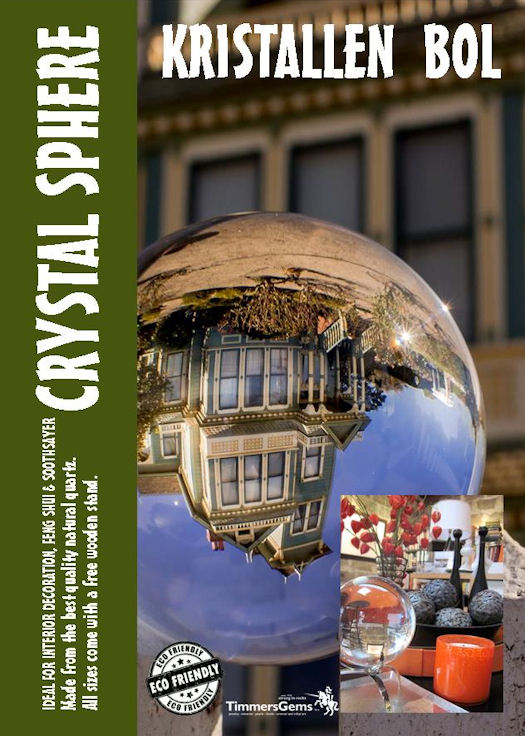
Fortune telling with quartz ball and quartz from the Coleman mines.
Fortune-telling is the attempt to gain insight into a question or situation through a standardized process or ritual. While these rituals serve a religious and regulatory function in some societies, fortune-telling can also be used in all cultures as a means of power or for pure profit. When advising someone, fortune-tellers claim to be able to "read" signs, events, or omens, or to be in contact with supposed supernatural powers. The oldest known form of fortune-telling is probably geomancy, and undoubtedly the most complex system is Western astrology. Methods used, some of which have a long tradition: astrology: the interpretation of the movements of celestial bodies to predict events on earth; other methods of character analysis such as graphology, physiognomy, phrenology (now entirely abandoned theory), and palmistry; numerology: the use of tools such as playing cards or tarot, tea leaves, a crystal or glass ball, dice, fire, water, and discarded salt; scapulomancy: a method of prediction using shoulder blades, used by shamans in Mongolia and the Ubykhs, among others, and plastromancy (using turtle shells); For predicting the future (prediction) the fortune teller often uses attributes such as: Tarot cards, Hand lines, The positions of the 'stars' in the year of birth (horoscopes), Coffee grounds, tea leaves, A glass or crystal ball, In China, Taoist symbolism is often used (see also: I Ching), In Russia, molten lead, tin or beeswax is dripped into water, The entrails of animals.


