


Description
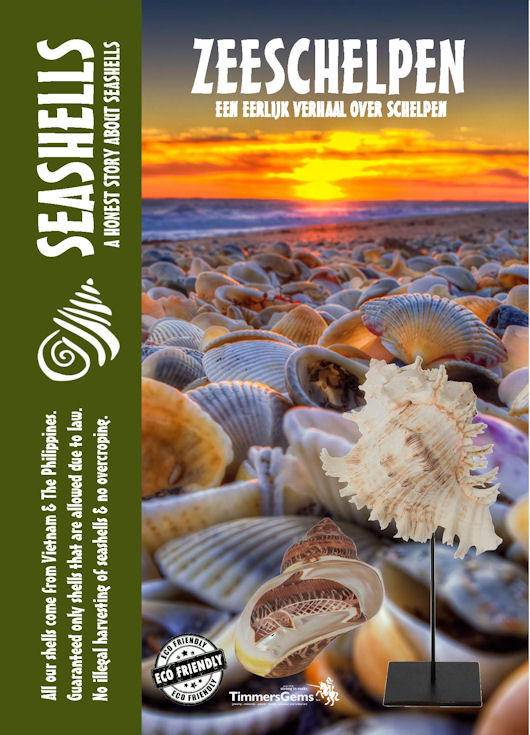
The scallop shell (Pecten jacobaeus) is a bivalve mollusk from the Pectinidae family. The scallop shell is found in the Mediterranean Sea. These animals feed on planktonic organisms and other suspended food particles, which they obtain by filtering seawater with their gills. Scallop shells have light-sensitive organs, "catadioptric eyes," located on small tentacles on the edge of the shell. These "eyes" operate by reflection and can distinguish between light and dark. This allows them to detect and react to potential predators. The reaction can consist of flight (see below) or simply closing the valves. The scallop shell lives flat on the seabed, with its convex valve on the underside. Young animals can attach themselves to a substrate with byssal threads. Adults are loose and prefer sandy bottoms. Scallop shells can move by forcibly closing their valves. In this case, the water forcibly leaves the shell on the side where the lock is located, giving the appearance of the shell biting its way through the water. The scallop shell has a roughly equilateral triangular shape with approximately 15 wide, radial, undulating main ribs. The main ribs are separated by an intercostal space that is approximately as wide as the main ribs themselves. A secondary sculpture of finer ribs lies over the main ribs and intercostal spaces. On either side of the umbo is a wing-shaped projection, the so-called auricle. The two auricles of a scallop shell are of unequal size. The two valves are not identical: the left valve is convex, the right valve almost flat. The shell can reach a width of approximately 20 cm. Shells can be uniformly yellow, salmon pink, red, and brown in color, while specimens with flamed color patterns also occur.


