


Description
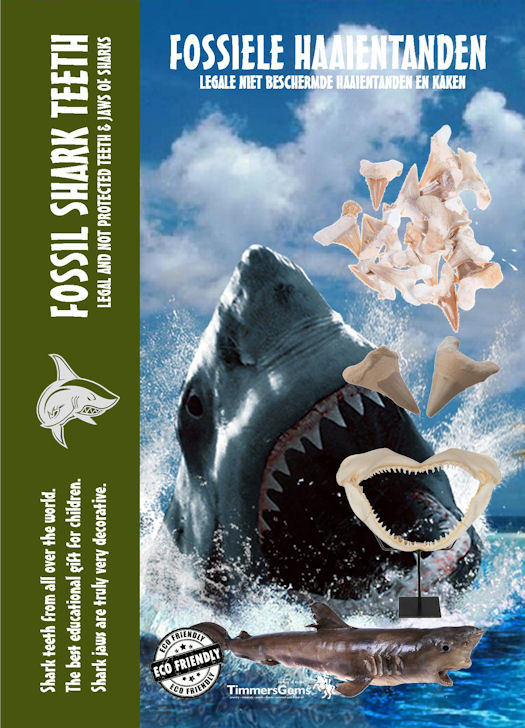
Shark teeth, formerly also called tongue stones or (Latin) glossopetrae, are fossilized shark teeth. The teeth are the body parts of sharks that are best preserved as fossils. This is because the entire skeleton of sharks, with the exception of the teeth, consists of cartilage, which generally does not fossilize. The oldest known shark teeth belong to shark species that lived approximately 450 million years ago, while in the North Sea basin, the most common shark teeth date from the Eocene and Oligocene epochs and are between 40 million and 65 million years old. Teeth from Megalodon, which lived between 1.5 and 16 million years ago, are the largest known, with a maximum length of 17 cm and are highly sought after by fossil shark tooth collectors. Smaller shark teeth are quite common in sediments from relatively deep seas. These fossils wash up on various Dutch beaches, especially in Zeeland and Zeeuws-Vlaanderen, such as near Cadzand. These teeth are primarily of Tertiary age (Eocene and Oligocene). Shark teeth were among the first fossils to be correctly identified. In the 16th century, the prevailing theory was that the Earth possessed an inner force capable of transforming objects within it into the likeness of living animals and plants. However, the Swiss naturalist Conrad Gesner (1516–1565) published a drawing in 1558 comparing fossil shark teeth with those of modern species. Later, the Danish researcher Nicolaus Steno (1638–1686) demonstrated that tongue stones found in mountains often bore signs of wear compared to the teeth of a recently beached shark. He also discovered that the rocks in which they were found were originally soft. Steno concluded that tongue stones were the teeth of sharks that had died long ago.
Shark teeth


