
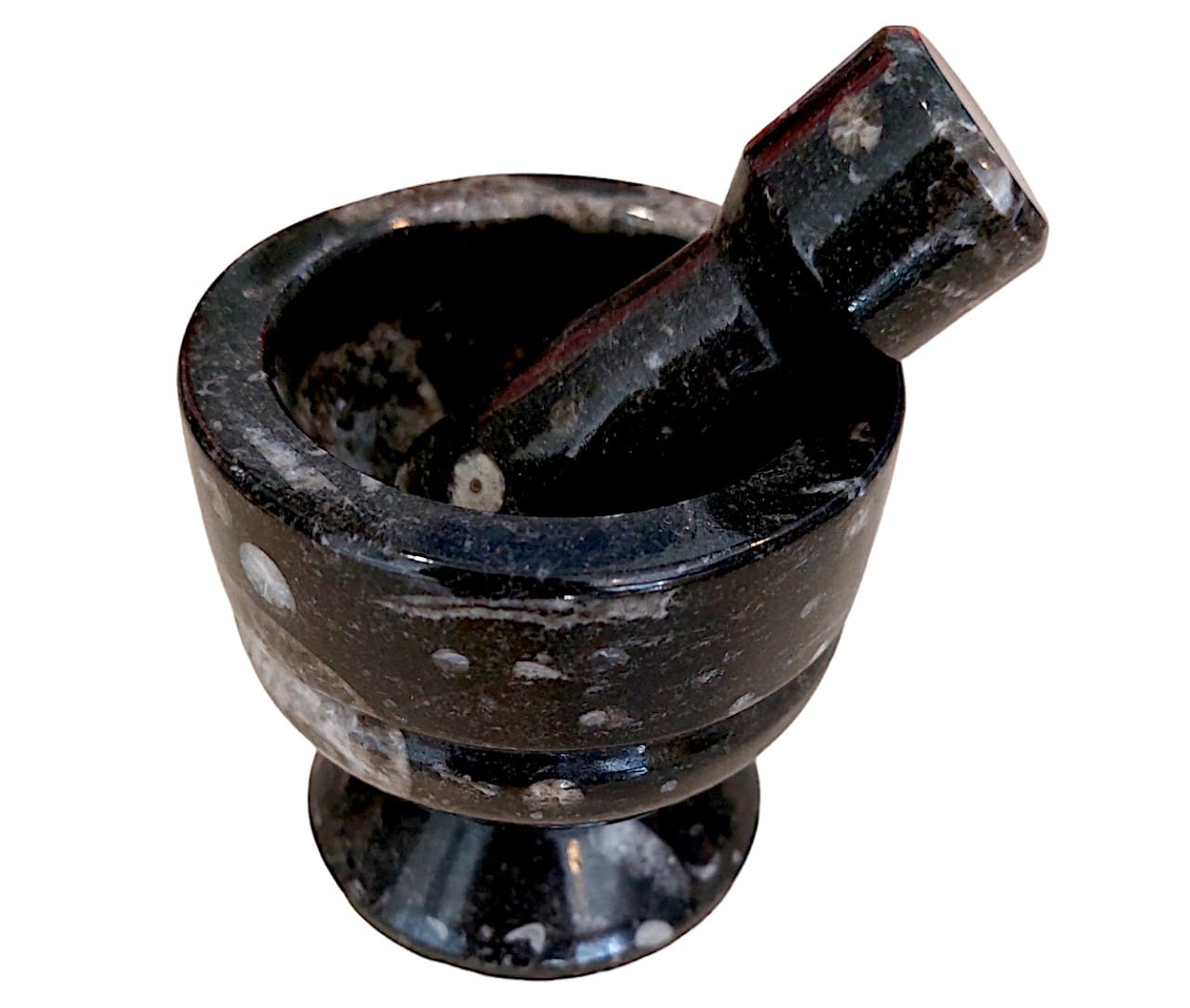
Description
Orthoceras is an extinct genus of molluscs that lived during the Middle Ordovician. This nautiloid cephalopod had a tapered, cylindrical, conical shell with closely spaced chambers containing a hollow and a convex septum, with a connecting tube in the center, the siphon. The shell was approximately 15 cm long. Orthoceras was a good swimmer, feeding on carrion and small animals. The shell always remained in a horizontal position while swimming. Fossils are all the remains and traces of plants and animals preserved in rock. Although this is often thought, fossils are not necessarily "petrified." Indeed, many fossils are not petrified. Even from very old rocks, fossil remains are known that have hardly changed. Furthermore, many people believe that fossils are always very old. This too is incorrect. Many very young fossils are known, formed during periods known to humans. The science that studies fossils is called paleontology. This field of knowledge aids in the study of rock sequences, a branch of geology called biostratigraphy. Because the remains of life only fossilize under specific conditions, fossil information is limited and, by definition, "incomplete." The word "fossil" often brings to mind the bones of dinosaurs or mammoths, and it is indeed true that the hard parts of an organism have the greatest chance of being preserved through fossilization. For vertebrates, these are the bones and especially the teeth. The softer tissues of the organism are preserved only in exceptional cases and are therefore much rarer. Softer tissues are only preserved if they are quickly buried under a layer that protects them from any form of decay or predation. With only the hard parts, it is sometimes difficult to form a good picture of the complete organism. A good example of this is the Conodonta, which were found in large numbers for a long time, but were only known from their teeth. Only when an imprint of the rest of such an animal was found was it revealed that it was a primitive form of the phylum Chordata. In other animal groups, other hard parts, such as shells, are often fossilized. There are several unusual forms of fossilization. For example, complete insects are sometimes found encased in amber, because the resin from which the amber is formed forms a good barrier against oxidation. This also applies on a larger scale to tar pits. A good example is the La Brea Tar Pits near Los Angeles. The bones of animals trapped in the tar pit were often exceptionally well preserved. Moreover, the trapped animals often attracted predators, which in turn became entangled. In this way, a "bone graveyard" was formed during the Pleistocene. In clay deposits in stagnant, anoxic water, exceptionally well-preserved fossils are often found. Due to the absence of oxygen, plants fossilize particularly well in these deposits. Very often, not the entire water column is anoxic, but only the lower portion. Such stratified water therefore has a normal oxygen content in the upper layer. Organisms die in the upper layer and then sink to the bottom, entering an anoxic environment where they are preserved. Living organisms can also accidentally enter the lower anoxic layer, causing them to die and fossilize. In such a deposit, fish are sometimes preserved in a cramped manner, indicating asphyxiation. A well-known rock with such fossils is the copper slate from Rotliegend in central Germany. In addition to remains originating from organisms themselves, traces actively or passively produced by organisms are also considered fossils. These include, for example, coprolites (fossilized feces) and trace fossils such as footprints and burrows. It is not always possible to determine the animal from which trace fossils originate


