
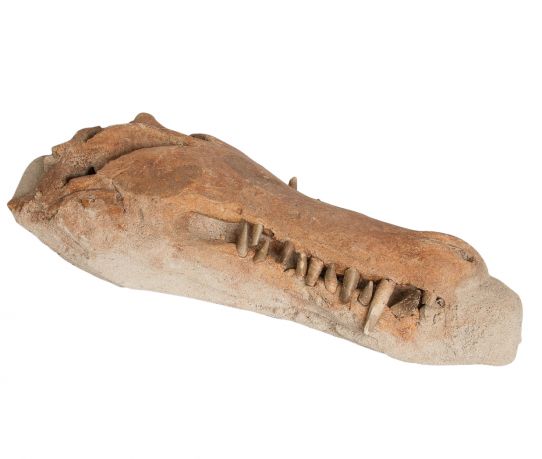
Description
Crocodiles (Crocodylidae) are a family of crocodilians (Crocodilia). This family includes the largest species, as well as some terrifying extinct ones. There are 15 species, making it the largest group of the 25 crocodilians. Alligators, caimans, and gharials are crocodilians but belong to different families. Crocodiles have a wide range and are found in Africa, Asia, Australia, and North America, while alligators live in North and South America. The largest species is the saltwater crocodile, whose record length is 8.25 meters. With a maximum length of less than two meters, the broad-nosed crocodile (Osteolaemus tetraspis) is the smallest species. The extinct Deinosuchus may have been up to 15 meters long. It is uncertain whether Deinosuchus is a member of the Crocodylidae. It was certainly a close relative. Aside from the size of the largest species, there are several physical characteristics that distinguish crocodiles from gharials (Gavialidae), alligators, and caimans (Alligatoridae). First, the skull; crocodiles have a relatively long skull of normal width. Crocodiles also lack a tongue, while caimans, alligators, and gharials do. The crocodile has a lobe, a kind of pouch under its mouth. Crocodiles are considerably larger on average and are generally more dangerous. The teeth are the key to distinguishing them from other families. At the front, the fourth pair of molars protrudes from the lower jaw, fitting into a recess in the upper jaw. The rest of the teeth are hidden within the mouth when it is closed. In alligators, these protruding teeth are absent, while in gharials, all teeth protrude. Crocodiles are polyphyodonts and can replace each of their 80 teeth up to 50 times during their 35-75 year lifespan. Along with each adult tooth, there is a small replacement tooth and an odontogenic stem cell in the dental lamina that can be activated. Most species prefer freshwater, but a few can be found in the sea. Only the saltwater crocodile lives more in the sea than in freshwater and can travel great distances. In addition to a bite, a crocodile can also deliver a ferocious tail swipe. The Nile crocodile and the saltwater crocodile are the most dangerous species and are responsible for hundreds of deaths annually in Asia and Africa. Crocodiles are very fast at close range. Many species can even run for a short distance. Their reflexes are also highly developed for surprising prey or for defensive purposes. Their jaws are powerful and contain numerous rows of teeth for tearing flesh. Crocodiles are opportunistic hunters that lie in ambush for prey and strike quickly when prey is within range. Often, prey is torn to pieces by multiple individuals. There are reports of large ungulates, lions, and even sharks falling prey to crocodiles.


