
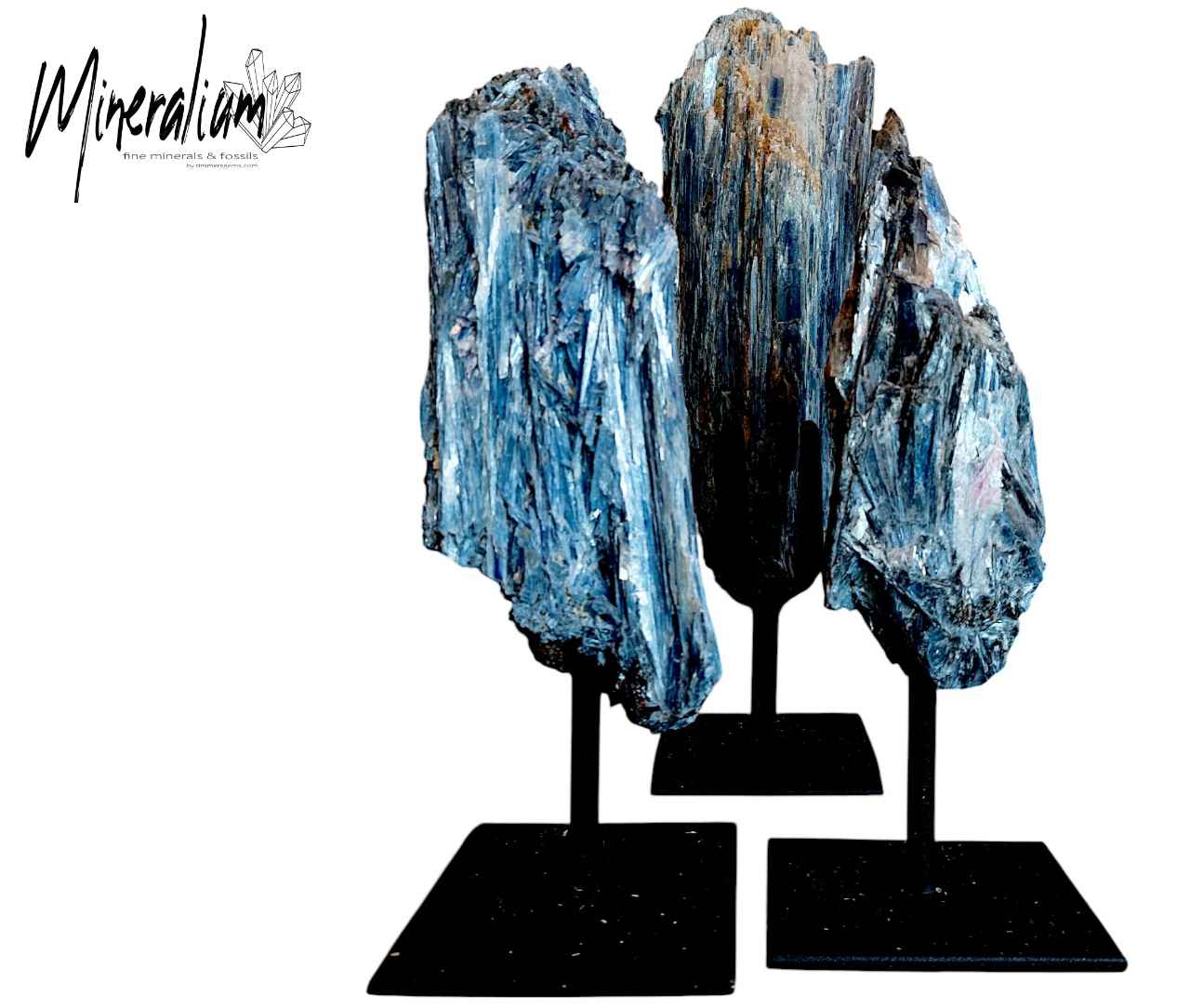
Description
The mineral kyanite, or disthene, is an aluminum silicate with the chemical formula Al2SiO5. It belongs to the nesosilicate group. This blue, gray, white, green, or black mineral has perfect cleavage along the crystal plane [100], a white streak color, and a vitreous to pearlescent luster. Its crystal system is triclinic, its average density is 3.61, and its hardness is 4 to 7. Kyanite is neither magnetic nor radioactive. The name of the mineral kyanite is derived from the Greek word kyanos, meaning "blue." Kyanite is a very common mineral found in many rocks. It occurs, among other places, in metamorphosed sedimentary rocks. Along with the other aluminum silicates sillimanite and andalusite, it is also an indicator of the depth and temperature at which a rock has undergone metamorphism. Kyanite is generally stable at temperatures below 650°C and at pressures exceeding 0.3 GPa (gigaPascals). Pressure and temperature are related, requiring a higher temperature (600°C) at high pressures (0.6 GPa) to form sillimanite from kyanite. At pressures below 0.3 GPa, andalusite is the stable aluminum silicate. Gemstone-quality kyanites are found in India, in gemstone deposits in Myanmar, and Korea. In the United States, kyanites are mined in California, Tennessee, Georgia, New Hampshire, and North Carolina. In Africa, kyanite occurs in Kenya and Tanzania, and in Europe in Russia, Switzerland, Austria, and France. Kyanite occurs in the sand fraction of Dutch Quaternary river sediments. In heavy mineral analysis conducted in the Netherlands by the National Geological Survey during the second half of the twentieth century, the mineral was classified in the so-called stable group. In this study, only the name disthene was used.


