
Description
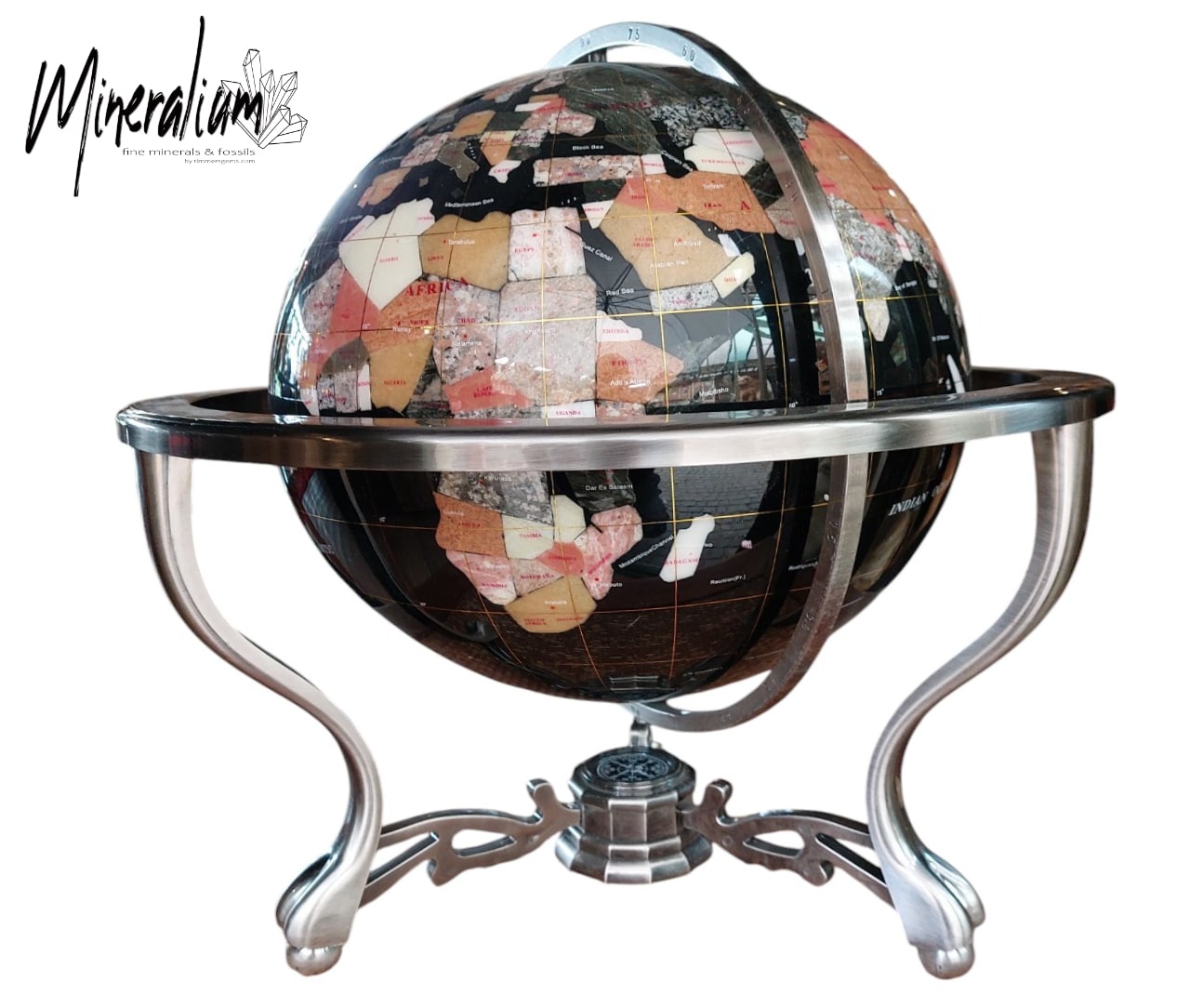
In 1996, Timmersgems took its first step as a European gemstone wholesaler by importing a unique gemstone globe, beautifully inlaid with precious stones from various countries. This innovative idea earned us the European Innovation Award in Hamburg. Today, the Lapis globe is available in three sizes (150-220-330 mm) and two versions (a standing globe or a tripod model). In 2008, we also developed the Onyx globe for the Philips Board of Directors, and in 2011, we added the Mother of Pearl globe. In 2019, the largest and most unique Lapis globe was presented at the Basel jewelry and watch fair. This unique globe can now be admired as a showpiece at Mineralium. So, with the primary stone types in three different sizes, we now have more than 10 models for the standing version and several models for the tripod version. Each one a unique design!
Our globes are crafted in Hong Kong. They are a true work of art, handcrafted with mosaics, composed of over 35 different gemstones in a single globe. Over a thousand hours of labor go into each globe.
The globe is encased in a plastic coating that ensures the rubbing letters remain safe even when touched, and our meridians are made with 585/000 (14 karat). Yellow gold – Fully guaranteed authentic gemstones, with no colorful imitations (these are easily recognizable by the folds on the globe). Lapis lazuli, also known as lapis lazuli, is an opaque semi-precious stone distinguished by its deep blue hue. It is not a mineral, but rather a rock, as it is composed of several components. The main mining takes place primarily in Afghanistan. The crucial component of lapis lazuli is lazurite, which makes up between 25% and 40%. This mineral acts as a feldspar substitute. Other essential elements include calcite in a brilliant white hue, sodalite with its captivating blue color, and pyrite, which shines with a metallic golden sheen. Additionally, the minerals augite, diopside, enstatite, micas, hauynite, hornblende, geyerite (a sulfur-bearing variety of lollingite), and nosean can also be found in lapis lazuli. Lapis lazuli does not have the highest hardness for a gemstone. With a hardness of 5.5 on the Mohs scale, the stone can easily be scratched by harder precious metals. Therefore, it is not advisable to store lapis lazuli jewelry with harder gemstones. Alternative healers attach spiritual energy to lapis lazuli. Lapis lazuli typically forms as a result of contact metamorphism within the womb of crystalline marble. Lapis lazuli has been a popular gemstone since ancient times. As early as 4000 BC, the ancient city of Ur was a bustling trading center. It was one of the valuable commodities in the exchanges between Sumer, Dilmun, and Meluhha. It also enjoyed great popularity in ancient Egypt. It served as inspiration for, among other things, Tutankhamun's death mask. Throughout the Middle East, the hunger for these products was so great that people began creating imitations as early as the 13th century BC. In the city of Sidon, for example, magnificent cylinder seals belonging to King Annipi and his father Adummu have been discovered, which have been given a deep, dark blue hue using cobalt salts. Lapis lazuli was also used in its ground state as a brilliant blue pigment, known as ultramarine, which was particularly popular in Renaissance painting.


