
Description
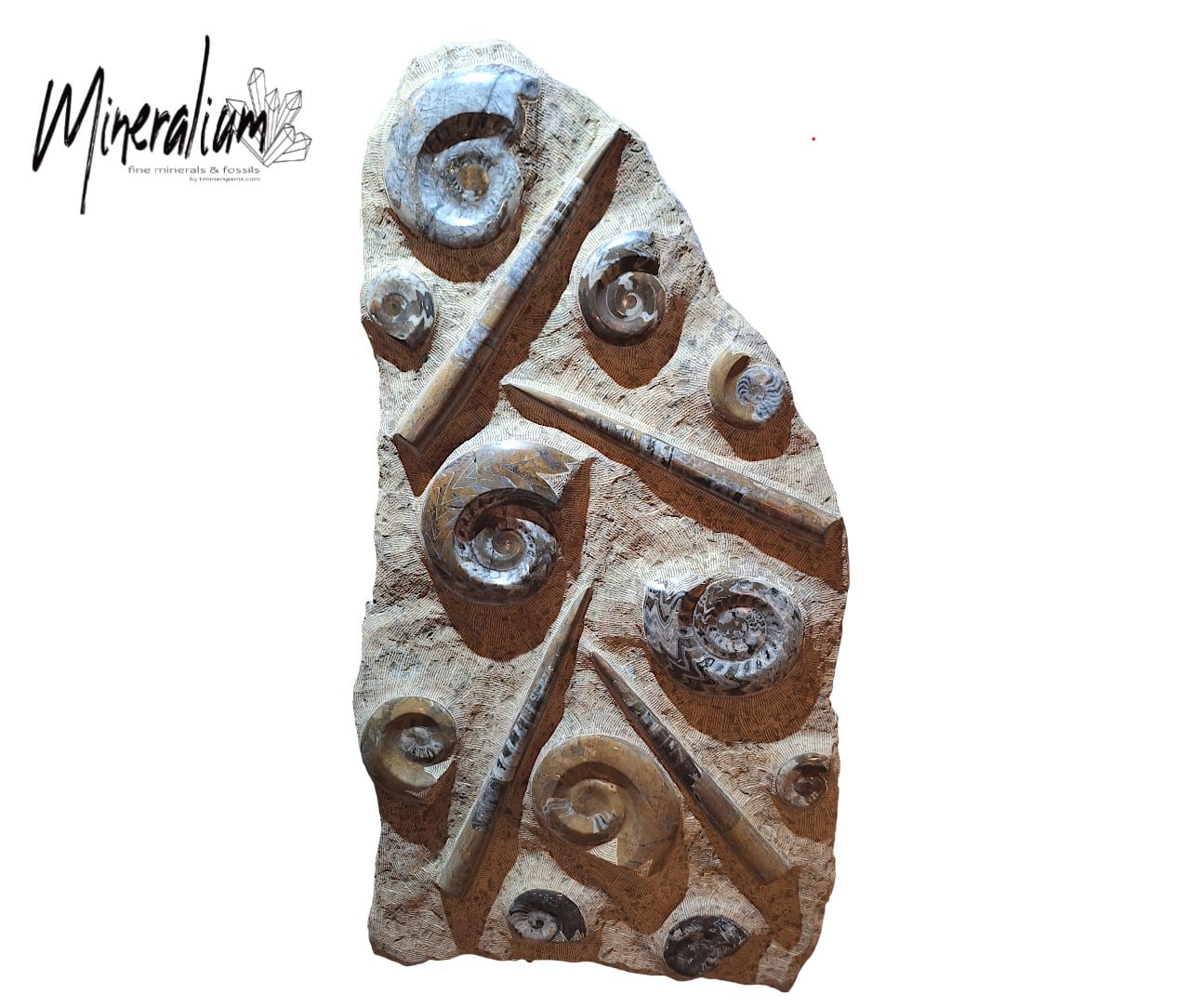
In the rugged south of Morocco, where the Atlas Mountains give way to the endless emptiness of the Sahara, lies the town of Erfoud. Today it's a dry, dusty region, but millions of years ago, the landscape was completely different. Where sand and rock now dominate, there once lay a warm, shallow sea teeming with life. In this primeval sea, ammonites swam with their perfectly coiled shells, like tiny submarines propelled by jets of water. Their spirals grew with each stage of life, chamber by chamber, like a work of art. Among them glided the elongated orthoceras, slender hunters with arrow-shaped shells and bodies segmented over time.
As the sea retreated and the earth rose into mountains, these creatures were covered by layers of sediment. Millions of years of pressure transformed mud into stone, and stone into a record of life. This is how the fossil kingdom that lies hidden today in the rocks around Erfoud was born.
Early in the morning, fossil hunters head into the hills. The air is cool, the sun still low. With hammers and chisels, they search for subtle patterns in the rock: a spiral that's just a little too perfect, an elongated shadow that reveals the shape of an orthoceras. Sometimes an ammonite lies almost at the surface, as if it has offered itself to time. Other times, a fossil must be extricated from the rock with patience and skill. In the workshops of Erfoud, the finds are carefully polished. The rough stone slowly transforms into a polished surface in which the ammonite or orthoceras becomes clearly visible. What was once a living creature in a tropical sea thus becomes a tangible piece of history—a fragment of a world that has been gone for hundreds of millions of years.


