
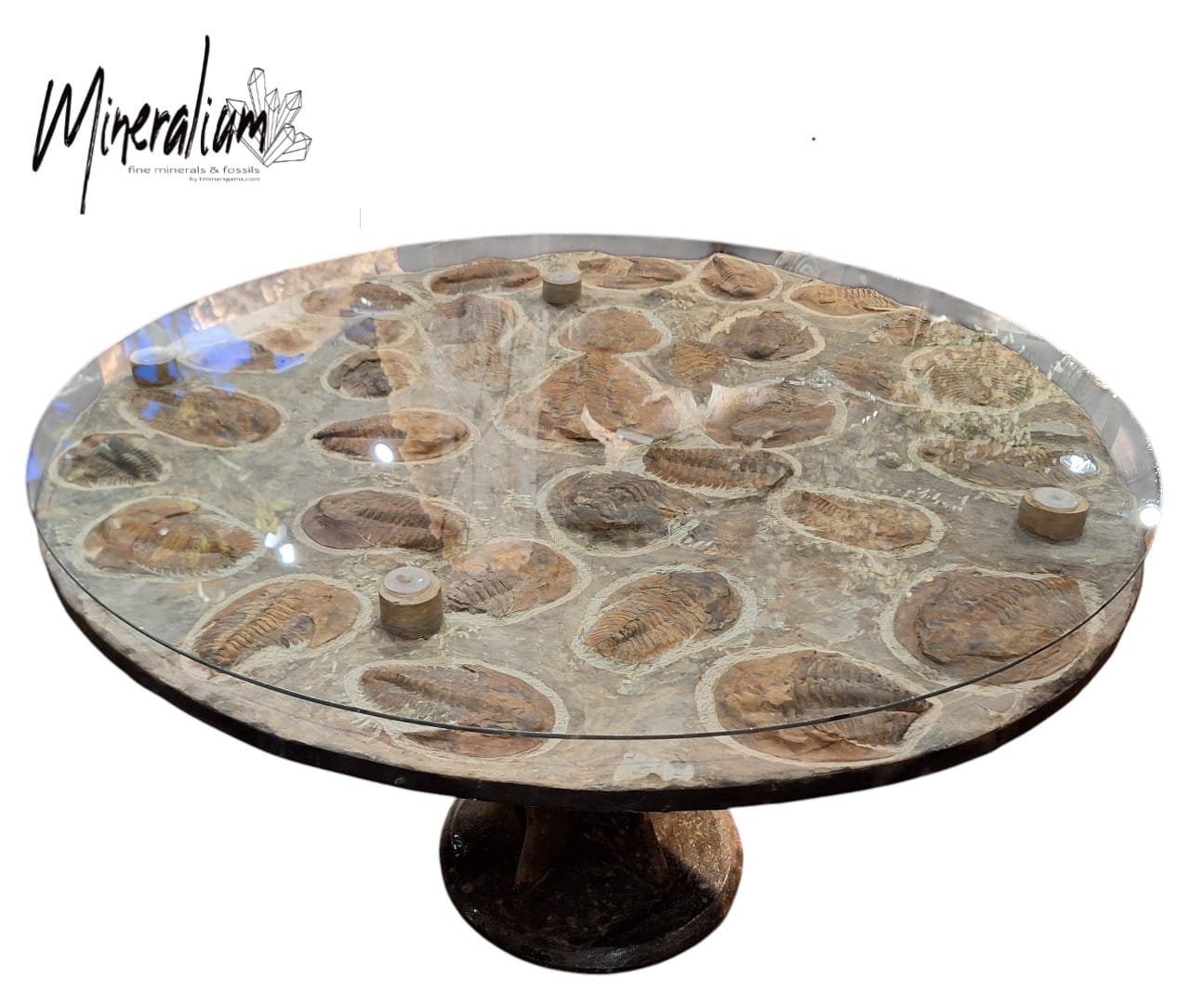
Description
Paradoxides is a genus of extinct trilobites and one of the best-known and largest, reaching a length of up to thirty-seven centimeters. They lived in the Middle Cambrian, 540 million years ago. Paradoxides is a genus of large to very large trilobites found worldwide. A record-breaking specimen of Paradoxides davidis is 37 centimeters. The genus' name was first announced in 1822 by Alexandre Brongniart. In his protologus, he described the species Paradoxides tessini, P. spinulosus, P. scaraboides, P. gibbosus, and P. laciniatus.
Paradoxides has a hemispherical head, free cheeks ending in a long, narrow, curved top, and sickle-shaped eyes, which provide almost 360° vision, but only horizontally. The long body consisted of nineteen to twenty-one segments and was adorned with long, curved lateral spines. The pygidium was quite small.
The exoskeleton of Paradoxides is large to very large, relatively flat, oval or obovate. It is about one and a half times longer than it is wide, with the greatest width at the genal spines. The head shield is almost semicircular and has long spines that grow from the corners of the cephalon. In trilobites, the dorsal suture usually lies along the top of the eye. In all Redlichiina, this suture extends slightly outward from the back of the eye to the posterior margin of the cephalon. This is called the opisthoparian, and it lies opposite the base of the pleural spines. From the front of the eye, the suture forms a smooth S-shape that intersects the anterior margin of the eye. The central raised portion of the cephalon (or glabella) is divided into the posterior occipital ring, followed by the first lobe. Both the occipital ring and the lobe are characterized by a groove running down their middle and have two lobes with sutures that are not connected along their middle. The frontal lobe is the widest part and resembles a segment of a circular band. It reaches almost the front of the cephalon. The eyelid is short compared to the first through third glabellar lobes. Paradoxides has a palate (or hypostome) whose anterior is aligned with the glabella and connected to the doublur (a condition scientifically called conterminant). Exceptionally, the hypostome is even fused with the anterior of the inner layer (called the rostral plate), a feature that sets it apart from all other trilobites, except for some Cambrian Corynexochida such as Oryctocephalus and Fieldaspis.


