
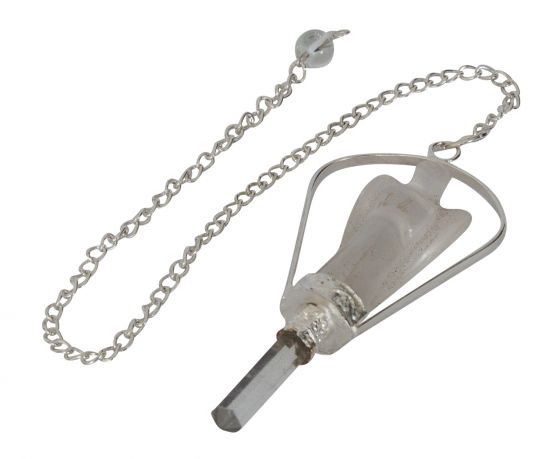
Description
Dowsing refers to answering (life) questions using a pendulum, a metal, glass, or wooden object often attached to a wire or chain. Like dowsing, dowsing is considered a form of radiesthesia and divination. Dowsing is used, among other things, to find possible answers to (life) questions or to detect so-called "energies." There is no scientific proof that dowsing works, but people who use the pendulum believe it works well. When dowsing, one holds one end of a flexible wire, rope, or chain, 5 to 10 centimeters long. An object made of metal, glass, wood, or other material, which acts as a small weight, hangs from the other end. This weight can be of all shapes and sizes. Asking questions must be done carefully to obtain a good answer. Therefore, the question must be asked precisely, and only one question can be asked at a time. The pendulum can then, by moving in a specific way, confirm the question or answer it with "no." Pendulum dowsing sometimes involves the use of a pendulum chart, which depicts several possible answers or an alphabet. Because the pendulum can move in all directions, the pendulum chart not only provides orientation but also allows for more detailed readings of the answer. Pendulum chart dowsing is one of the many tools complementary therapists use to access clients' subconscious minds.
Rock crystal is the colorless and most common variety of the mineral quartz (silicon dioxide, SiO2). The name "rock crystal" is derived from the Greek word "krustallos," meaning ice. It was believed that rock crystal was ice shaped by the gods. Rock crystal was already known during the Mesolithic period. During the Roman period, it was brought from the Alps under the name "petrified ice." Theofratus called it "krystallos." Pliny the Elder also mentions it. The name "quartz" was introduced in 1529 by Georgius Agricola. Eastern peoples considered rock crystal the stone of patience and perfection. Tibetans use rock crystal to treat wounds. The choice of rock crystal as a drinking glass or as part of medieval jewelry can be attributed to the belief that these crystals would break or discolor when they came into contact with poison. Thus, the chain became an amulet that protected the king. Compare the Rudolphinian imperial crown and the chain of the Jehovah's Witnesses. Origin: Megnathites, pegmatites, hydrothermal and alpine veins, alluvial deposits. Occurrence: Rock crystal is widespread in nature, but not always in gem quality. Historically known sources are India and Sri Lanka (the Tatnaputi area). Iridescent quartz from the Poona region in India and Myanmar is rare. Beautiful crystals come from Kenya and Madagascar, as well as Brazil (Minas Gerais). Goisas, Bahia, and French Guiana. In the United States, rock crystal occurs in pegmatites, including in Maine (near Ausburn), New York, North Carolina, Arkansas (Crystal Peak), and California. Of particular significance are occurrences in the Alps. Rock crystals are found in Switzerland (for example, near Urim, where a 135 kg crystal was found in the area of St. Gotthard and Grimsel), and in Austria (in 1965, a crystal weighing almost 1000 kg was found in a cavity near the Grossglockner). Rock crystals are also found in Germany, the Czech Republic, Poland, and France. Unique cut rock crystals are held in the collections of various museums. The Smithsonian Institution, Washington, owns a 7000-carat cut stone and a spherical rock crystal with a diameter of 33 cm and a weight of 48.5 kg; this one originates from Burma and was cut in China.


