

Description
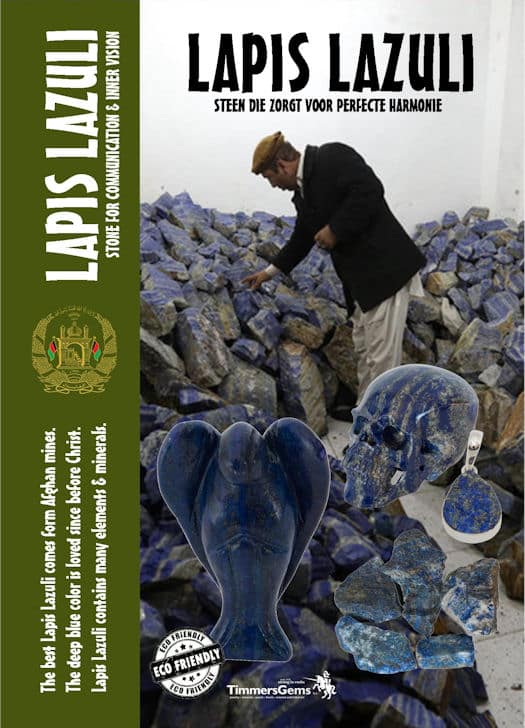
Lapis lazuli, or lapis lazuli, is an opaque semi-precious stone with an intense azure color. It is not a mineral but a rock, as it consists of more than one component. It is primarily mined in Afghanistan. The main component of lapis lazuli is lazurite (25% to 40%), a feldspar substitute with the chemical formula (Na,Ca)8(AlSiO4)6(S,SO4,Cl)1-2. Other important components are calcite (white), sodalite (blue), and pyrite (yellow – metallic luster). Lapis lazuli can also contain the minerals augite, diopside, enstatite, micas, hauynite, hornblende, geyerite (a sulfur-rich variety of lollingite), and nosean. Lapis lazuli is not particularly hard for a gemstone. On the Mohs scale, its hardness is 5.5, meaning it can easily be scratched by harder gemstones. Therefore, it is unwise to store lapis lazuli jewelry together with harder gemstones. Alternative healers attribute spiritual powers to lapis lazuli. Lapis lazuli is usually formed through contact metamorphism in crystalline marble. Lapis lazuli has been known since antiquity. It was already being traded in the city of Ur as early as 4000 BC. It was one of the commodities of the trade between Sumer, Dilmun, and Melucha. It was also highly prized in ancient Egypt. For example, it was used for the death mask of Tutankhamun. Demand was so high throughout the Middle East that imitations were being made as early as the 13th century BC. For example, cylinder seals from King Annipi and his father Adummu, dyed a dark blue with the help of cobalt salts, are known from the city of Sidon. Lapis lazuli was also used in ground form as a blue dye (ultramarine), which was also very popular in Renaissance painting.


