

Description
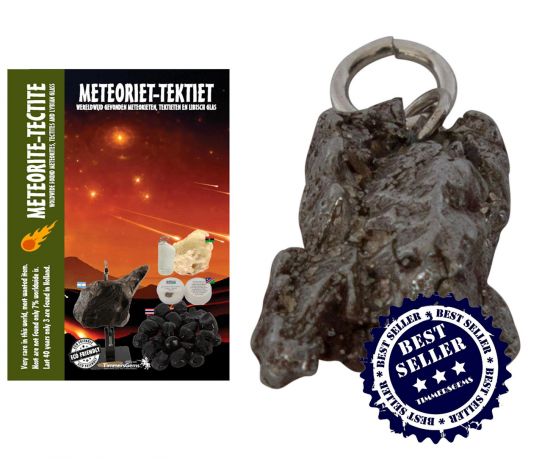
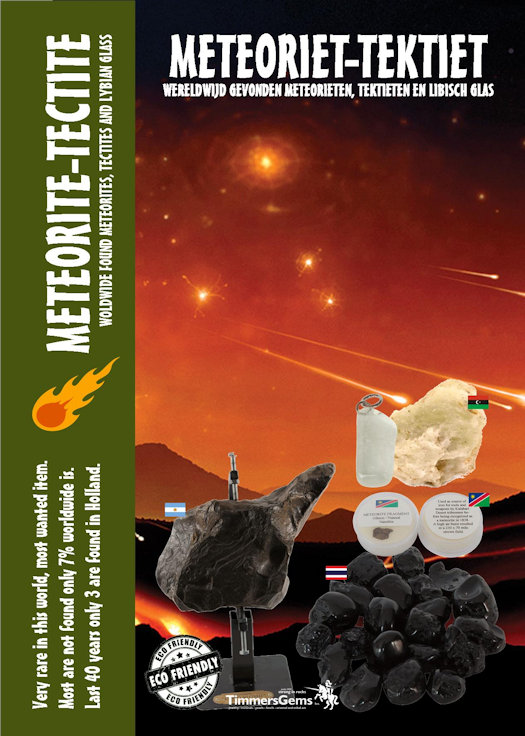
Tektites are fragments of glass of terrestrial origin, named after the Greek word tektos, meaning molten. For a long time, it was unclear how tektites form. Most scientists now believe that tektites are solidified fragments of terrestrial rocks that melt after a meteorite impact, are ejected, and then fall back to Earth. During the fall, the fragments solidify into a glassy mass. The surface of a tektite often exhibits characteristic features that formed during the impact. Because tektites form from terrestrial rocks, they are rich in silica. Archaeological discoveries indicate that tektites have been known since prehistoric times. They were used as a raw material for making tools, and later for amulets. The oldest finds date back to the Stone Age (Paleolithic). The most prized tektites come from Korath in Thailand.
A meteorite is the part of a meteoroid that impacts Earth after falling through the atmosphere from space. During its journey through the atmosphere, the material slows down significantly and becomes very hot; this can be seen as a meteor. Essentially, a meteorite is debris from space. The composition of meteorites can sometimes determine their origin. For example, more than twenty have been found that originated on the moon. This involves material knocked off the moon by another meteorite. Meteorites such as ALH84001 have also been found, originating from Mars. In many cases, however, the meteorite originates from the asteroid belt between Mars and Jupiter. Whether meteorites of cometary origin also exist is still under debate. It is possible that some rare, very fragile types of carbonaceous meteorites originate from short-period comets. Much of the debris that comes into contact with the atmosphere does not reach Earth but burns up due to atmospheric drag. The fragments that burn up are visible at night as meteors, also called star showers or shooting stars. Larger pieces that don't burn up completely but fall partially to Earth as meteorites form a bolide (fireball) as they pass through the atmosphere. The impressive phenomenon can be demonstrated, for example, by the Sikhote-Alin bolide. It was clearly visible in broad daylight. The fireball caused by the Dutch Glanerbrug meteorite from April 1990 was visible just before sunset.


