
Description
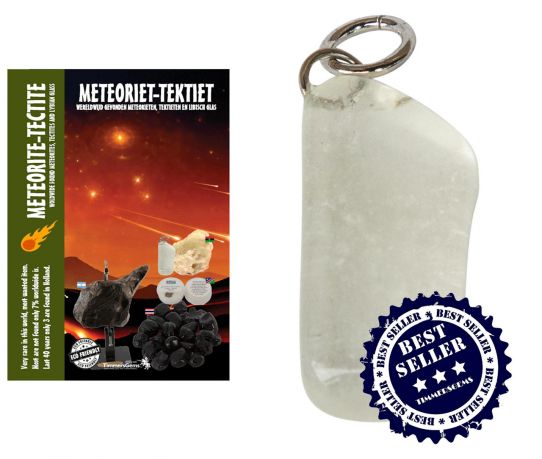
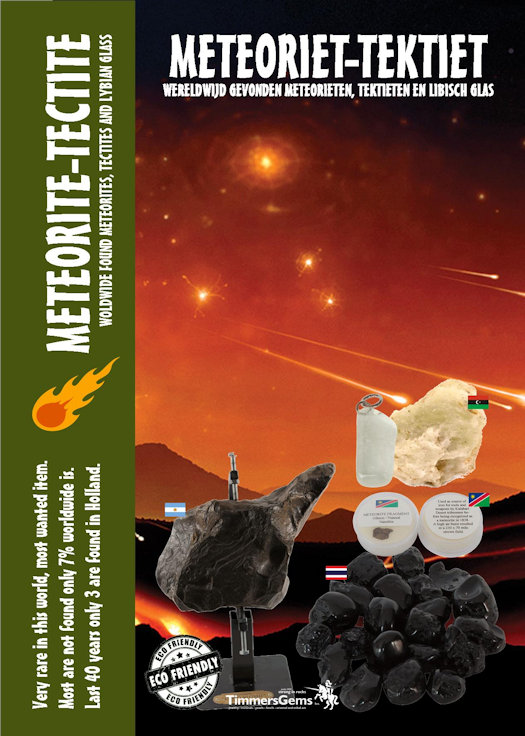
Tektites are pieces of glass of terrestrial origin and are named after the Greek word tektos, meaning molten. Libyan glass in Libya and Egypt is light yellow to yellow-green, weighs up to 5 kilograms, and is suitable for faceting.
Because tektites likely form during meteorite impacts, their occurrences are often limited to relatively small areas, known as strewn fields. The best-known tektites come from the Czech Republic, where they are found in the Vltava region; they are therefore called moldavites and were discovered in 1788. Tektites have been found in numerous locations in Bohemia and Moravia. Visually, they are distinguished by their shape, color, size, and surface. It is suspected that there is a connection with a meteorite crater, the Nördlinger Ries in Germany. The age of this crater is dated to 14.8 Ma. The tektites weigh from approximately 8 grams to 110 grams. Other sites include Besednice, Lodenice, Habri, Kamenny, Újezd, and Slavče. Moldavites are found in the sediments of the Upper Miocene, but also in younger deposits. In Moravia, Moldavites are darker, less transparent, and have a smoother surface; however, they are larger and can weigh up to 260 grams. The best-known Moravian sites are Kajotice, Slavice, Stepanovice, Mohelno, and Dukovany. Moldavites are also sometimes found in Germany near Dresden and in Austria. Other tektites are dark brown to black. The names depend on the locations: Indochinites occur in Vietnam, Cambodia, and Laos (Indochina); there they are blackish-green, have a smoother surface, and weigh up to 3 kilograms. Philipponite or rizalite is found in the Philippines. Billitonites are found on the Malay Peninsula and on the islands of Banak, Billiton, and Sumatra. Javaite is found on Java; these stones are black. Irgizite in Kazakhstan. Australite in Australia. Darwin glass, on the island of Tasmania, which is lighter and suitable for facet cutting. Black Bediasite occurs on the American continent, primarily in the United States, specifically in Texas. Dark green Georgianite in Georgia, Peru, and Colombia.
A meteorite is the part of a meteoroid that impacts Earth after falling through the atmosphere from space. During its journey through the atmosphere, the material slows down significantly and becomes very hot; this can be seen as a meteor. Essentially, a meteorite is debris from space. The composition of meteorites can sometimes determine their origin. For example, more than twenty have been found that originated on the moon. This involves material knocked off the moon by another meteorite. Meteorites such as ALH84001 have also been found, originating from Mars. In many cases, however, the meteorite originates from the asteroid belt between Mars and Jupiter. Whether meteorites of cometary origin also exist is still under debate. It is possible that some rare, very fragile types of carbonaceous meteorites originate from short-period comets. Much of the debris that comes into contact with the atmosphere does not reach Earth but burns up due to atmospheric drag. The fragments that burn up are visible at night as meteors, also called star showers or shooting stars. Larger pieces that don't burn up completely but fall partially to Earth as meteorites form a bolide (fireball) as they pass through the atmosphere. The impressive phenomenon can be demonstrated, for example, by the Sikhote-Alin bolide. It was clearly visible in broad daylight. The fireball caused by the Dutch Glanerbrug meteorite from April 1990 was visible just before sunset.


