
Description
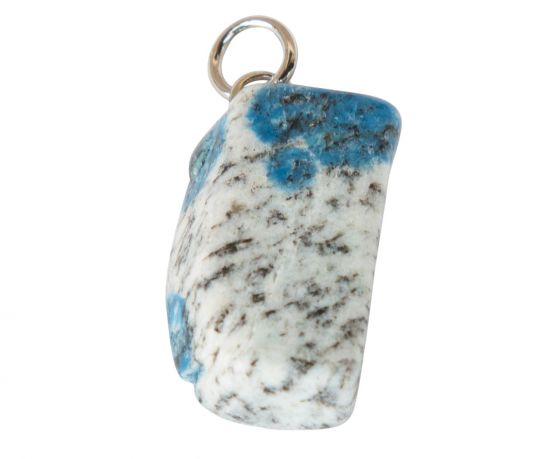
This stone contains granite from the mountain, embedded with spheres of blue Azurite. This powerful blue stone is highly prized; it opens and cleanses the third eye and crown chakras. Azurite guides psychic development and enhances metaphysical powers, making it ideal for clairvoyants, mediums, channelers, and others, especially when placed on the third eye. It elevates consciousness to the highest level and promotes a meditative, channeling state, enlightens the soul, and is a powerful healer and energy conductor. It removes emotional debris and old fears, cleanses the emotional body, and brings inner peace. The fact that Azurite stimulates inner vision and helps interpret dreams more easily is also valuable for those seeking spirituality. This stone, a pure embodiment of the blue ray, can collapse the ego's house of cards and reveal the truth behind the illusions your ego so readily presents. It helps you gain insight, but without judgment, as it helps you better understand the true motives of yourself and others. A very good stone for starting a business or entering into a partnership, as this crystal brings the truth to light. It also aids thinking, and therefore helps with studying, giving lectures, and memory. Azurite strengthens your astral and etheric bodies, making you less vulnerable to spiritual attacks or entities. It helps close holes in your aura. It soothes migraines, reduces tinnitus, and is helpful for dizziness. It is also helpful for those who tell untruths out of fear.
The mineral azurite is a copper carbonate with the chemical formula Cu3(CO3)2(OH)2. The typically transparent to translucent azurite has a light blue streak color, a vitreous luster, and a monoclinic crystal system. Its average density is 3.83 and its hardness is 3.5 to 4. Azurite is not radioactive and bright blue to dark purple pleochroic. The name azurite is derived from the Persian word lazhward, meaning "blue." The very common azurite occurs primarily in the oxidized portions of copper deposits or as a secondary mineral in carbonate-rich waters. It also forms when copper-bearing solutions react with limestone. The type locality of azurite is Chessy-les-Mines, Rhône-Alpes, France. Azurite has been used for centuries as a blue pigment. It was formerly known as Azurro Della Magna (from the Italian). When mixed with oil, it turns slightly green. When mixed with egg yolk, it turns grayish-green. Azurite is often used in jewelry and is a popular mineral among collectors.
K2 (Urdu: کے ٹو, Kaitu) is an 8,611-meter-high mountain peak on the Pakistan-China border in the Karakoram. It is the second-highest mountain in the world, after Mount Everest. K2 is considered the "holy grail" for mountaineers and, according to many experts, the most difficult peak in the world to climb. The mountain has a fatality rate of 25%. K2 remained nameless for a long time because it was not directly visible to the local population. In 1856, the area was surveyed and described by British Colonel Thomas George Montgomerie as part of the Great Trigonometrical Survey. He abbreviated the mountain "K2" because it was the second mountain Montgomerie encountered in the Karakoram. Montgomerie numbered the mountains in the order in which he saw them. The other peaks were originally named K1, K3, K4, and K5, but these were eventually renamed Masherbrum, Broad Peak, Gasherbrum II, and Gasherbrum I, respectively. The reason the name K2 stuck is that there was no local name. Other, lesser-known names for K2 include Mount Godwin-Austen, Lamba Pahar ("Long Mountain" in Urdu), Qogir Feng, Chogori, or Dapsang. In Balti, the only name known is K2, which is pronounced "Ketu.".


