
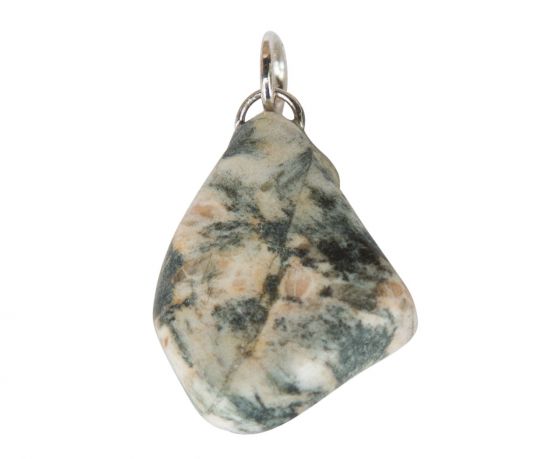
Description
Gedrite is a crystal belonging to the orthorhombic ferromagnesian subgroup of the amphibole supergroup of double-chain inosilicate minerals with the ideal formula: Mg2(Mg3Al2)(Si6Al2)O22(OH)2 Gedrite is the magnesium (Mg) rich endmember of the solid solution series, with the divalent cations of magnesium readily replacing ferrous iron (Fe), giving the iron-rich endmember 'ferrogedrite', with the formula: Fe2 + 2(Fe2 + 3Al2)(Si6Al2)O22(OH)2. However, pure endmembers are very rare, with often one of the mentioned cations dominating the composition. Thus, the formula can be written in such a way to show common intermediate gerdite samples: (Mg,Fe)2 + 2(Mg,Fe)2 + 3Al2(Al2Si6O22)(OH)2. Divalent manganese (Mn) can replace some of the magnesium. Trivalent iron or titanium4+ can replace some aluminum (Al). Fluorine and chlorine are often substitutes for the hydroxyl (OH) in amphoboles. Other chemical impurities can include calcium, sodium, and potassium. Gedrite also forms a series with another ferromagnesian amphibole, anthophyllite. Gedrite occurs in contact and medium- to high-grade metamorphic rocks in association with garnet, cordierite, anthophyllite, cummingtonite, sapphirine, sillimanite, kyanite, quartz, staurolite, and biotite. Gedrite was first described for an occurrence in Gedres, France, in 1836.


