
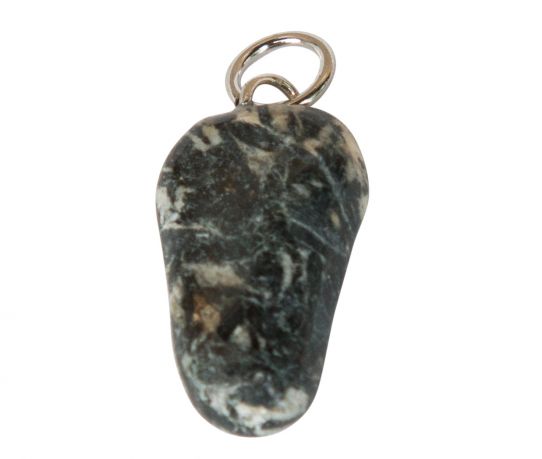
Description
The mineral hornblende is a calcium-magnesium-iron-aluminum inosilicate with the chemical formula Ca2(Mg,Fe,Al)5(Al,Si)8O22(OH)2. It is the most common of the amphiboles. Black, green, or brown to greenish-brown hornblende has a vitreous to pearlescent luster and a white streaked color. The crystal system is monoclinic. The average density is 3.23 and the hardness is 5 to 6. The name of the mineral hornblende comes from German, a compound of the German "Horn" and the verb for "to blind" or "to deceive." Like other amphiboles, hornblende occurs in igneous and metamorphic rocks, such as granites and schists, respectively. Hornblende occurs in the sand fraction of Dutch Quaternary river sediments, including those of the Rhine. In the heavy mineral analysis conducted in the Netherlands by the National Geological Survey during the second half of the twentieth century, the mineral is classified in the so-called unstable group. Several varieties are distinguished, including one that is highly characteristic of Meuse sands deposited before 400,000 years ago.


