
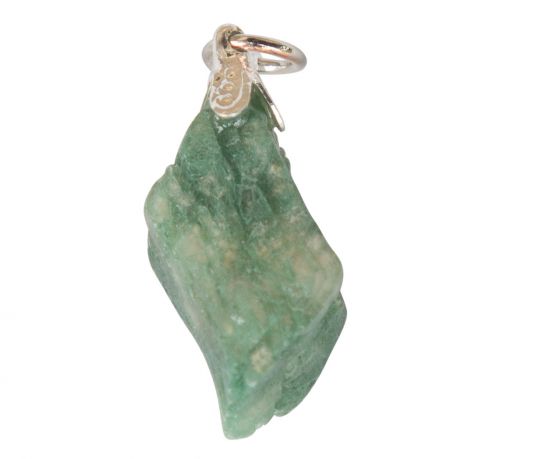
Description
The mineral heulandite is a complex of hydrated calcium-aluminum tectosilicates with the general chemical formula (Ba, Sr, K, Ca, Na)2-3Al3(Al, Si)2Si13O36·12(H2O). It belongs to the zeolites. The composition of heulandite, which in addition to calcium may contain the elements barium, strontium, potassium, and/or sodium, determines its precise properties. The general properties are white, yellow, light red, light brown, or light gray colors and a white streak color, a vitreous to pearlescent luster, and perfect cleavage along the crystal plane [010]. The average density ranges from 2.2 to 2.35, and the hardness is 3 to 3.5. The crystal system is monoclinic, and the mineral's radioactivity is barely measurable. The gamma ray value, according to the American Petroleum Institute, ranges from 4.3 to 47.06. Heulandite is named after the English mineral collector John Henry Heuland (1778–1856). Like other zeolites, heulandite occurs in a variety of environments: volcanic and metamorphic rocks, pegmatites, tuffites, and deep-sea sediments. The type locality for the calcium variety of heulandite is Glasgow, Scotland.


