
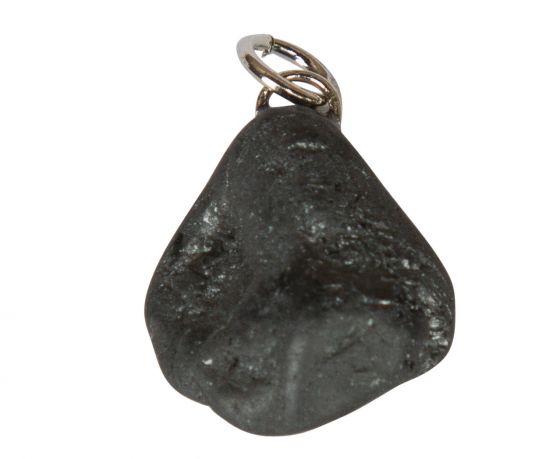
Description
The mineral columbite is an iron-manganese-tantalum-niobium oxide with the chemical formula (Fe,Mn)(Ta,Nb)2O6. It is also known as niobite, niobite-tantalite, and columbate. Columbite is an important source of niobium. It is also one of the components of coltan. Columbite was named after the country of Colombia in the 17th century. The mineral was discovered in Haddam, Connecticut, United States. In 1844, the German chemist Heinrich Rose determined that the mineral contains niobium and tantalum. The opaque black to brownish-black columbite has an orthorhombic crystal system. The crystals are usually massive and granular. The fracture surface is subconchoidal and has a distinct cleavage along the fracture plane [010]. The hardness is 6 on the Mohs scale, and the relative density is 6.3 g/cm³. Columbite is neither magnetic nor radioactive. It is primarily found as a secondary mineral in or on pegmatites. It is found in areas such as: Germany near Bodenmais, Waidhaus, and Tirschenreuth; France near Échassières and Ébreuil; various locations in Finland, Sweden, and Norway; Madagascar; and the United States in Connecticut, Massachusetts, North Carolina, and Colorado; and Greenland.


