
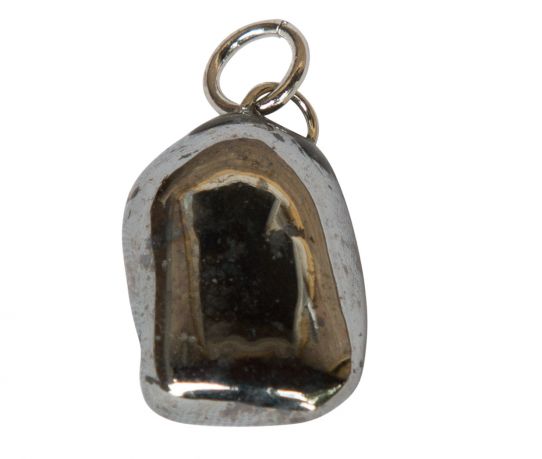
Description
The mineral cobaltite is a cobalt-arsenic sulfide, with the chemical formula CoAsS. It belongs to the so-called sulfosalts. Cobaltite is named after its principal component element: cobalt. This name is derived from the German word kobold (kobold). The mineral was discovered in 1797 in Nyköping, Sweden. The type locality of the mineral is Cobalt in Ontario, Canada. Red to silvery-white cobaltite has an orthorhombic crystal system. The crystals are usually granular and massive; they rarely occur fibrous. The fracture surface is brittle and exhibits perfect cleavage along the fracture plane [001]. Its hardness is 5.5 on the Mohs scale, and its relative density is approximately 6.33 g/cm³. Cobaltite has the unique property of becoming magnetic after heating. In addition to cobalt and arsenic, the mineral can contain up to 10% iron and nickel. The violet color of some specimens may indicate erythrite inclusions. Cobaltite is not radioactive. Cobaltite occurs in hydrothermal veins and metamorphic rocks. It is found with, among others, magnetite, sphalerite, chalcopyrite, skutterudite, allanite, zoisite, scapolite, titanite, calcite, gersdorffite, ullmannite, lollingite, millerite, pyrite, and marcasite. It is a typical ore mineral and, despite its rarity, is considered an important source of cobalt. Cobaltite is found in Sweden, Norway, Germany, Cornwall, England, Canada, Australia, Congo, and Morocco.


