
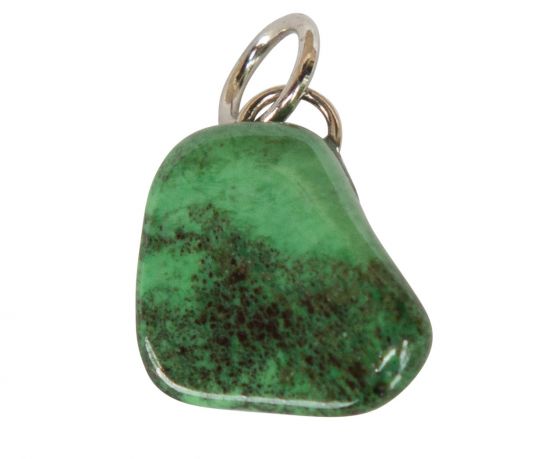
Description
Chromium diopside is a mineral and a variety of diopside, named for its chromium admixtures. It has only recently been used as a gemstone but is becoming increasingly popular. Chromium diopside occurs in ultramafic rocks and sometimes forms crystals up to 10 cm in size. Some of the finest chromium diopsides come from the basic Inagli Massif in Siberia and are incorrectly called Siberian emeralds. Smaller deposits are known from the Urals. On the American continent, stones occur in Cuba, Mexico, and Brazil. Other deposits are in Kenya, New Zealand, Australia, Japan, and Madagascar. In Europe, chromium diopside is found in Finland. The mineral dioptase is a copper silicate with the chemical formula CuSiO2(OH)2. It belongs to the cyclosilicates. The transparent to translucent dark blue-green, emerald-green, or turquoise dioptase has a vitreous luster, a green streak color, and good cleavage along the crystal plane [1011]. The crystal system is trigonal. Dioptase has an average density of 3.31, a hardness of 5, and is not radioactive. The birefringence of dioptase is 0.0510 to 0.0530. The name of the mineral dioptase is derived from the Greek words dia ("through") and optamai, meaning "sight." Dioptase is a secondary mineral found in oxidized copper deposits. The type localities of dioptase are Tsumeb and Cochab in Namibia and Altyn Tube in Kazakhstan. The mineral is also found in the Christmas Mine, Gila County, Arizona, United States. Dioptase is a highly sought-after mineral among mineral collectors. It has no other uses. Dioptase is certainly beautiful enough to be used as a gemstone, but not hard and strong enough. Therefore, it is very rarely cut into a gemstone.


