
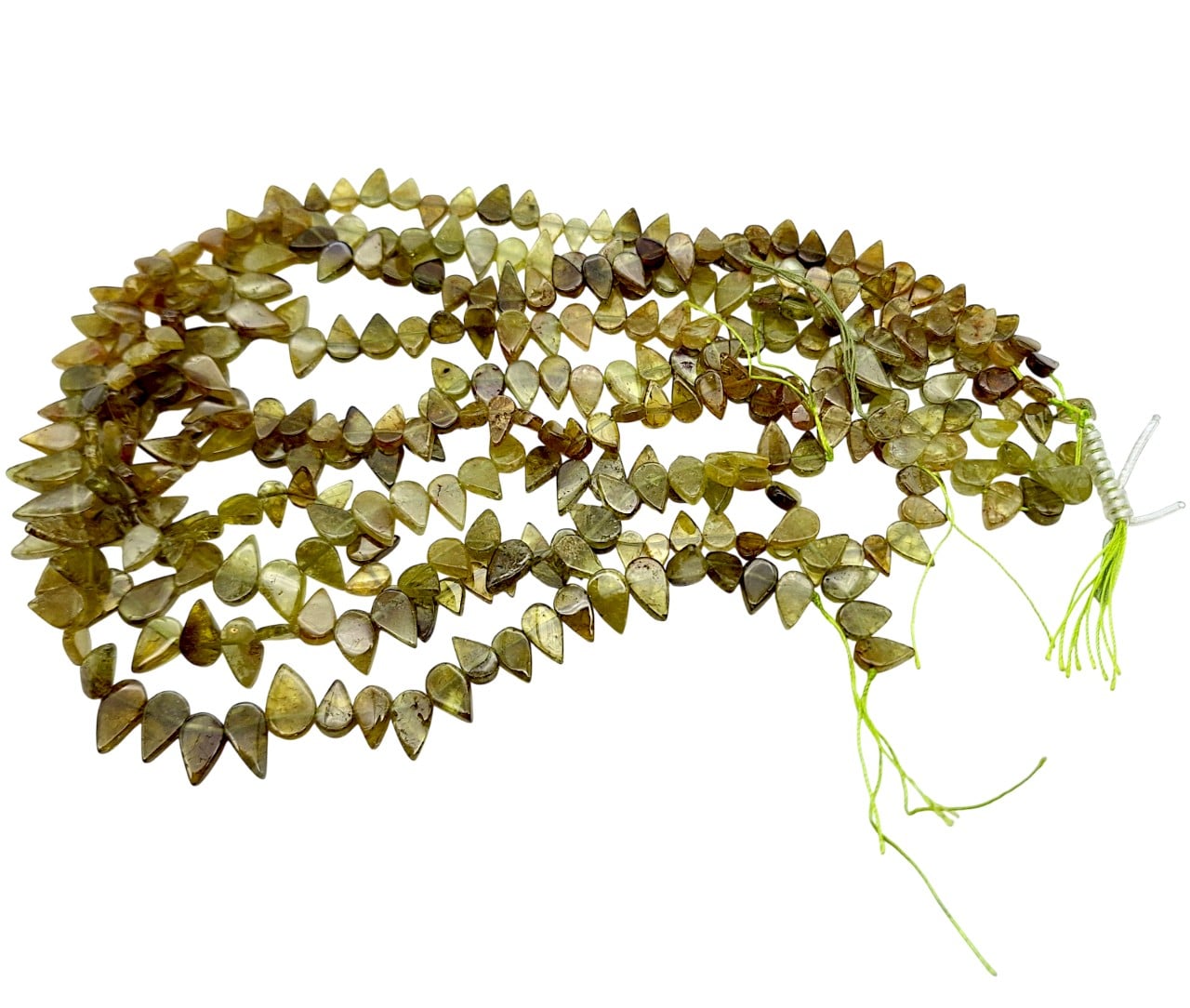
Description
The mineral olivine (peridot) is a nesosilicate with the chemical formula (Mg,Fe)2SiO4, where the end-members between magnesium and iron are formed by the mineral series forsterite (rich in Mg) and fayalite (rich in Fe). Olivine has an orthorhombic crystal system and crystallizes in a slightly oblate form, but can also occur as massive or granular. It fractures conchoidally and is somewhat brittle. The hardness of olivine ranges from 6.5 to 7. Its average density is 3.32 kg/l, and the mineral has a vitreous luster. It usually has an olive green color (hence the name), but it can also be reddish due to the oxidation of trivalent iron. It is transparent to translucent. Olivine occurs as a rock-forming mineral in mafic igneous rocks and in certain metamorphic rocks. It has also been discovered in meteorites and traced on Mars by the American Mars Odyssey space probe. The Mars Exploration Rovers further confirmed its presence. Olivine is formed in magma rich in magnesium and poor in silicates (silicon dioxide). It is an important mineral in rocks such as gabbro, norite, the mantle rock peridotite (dunite), and as small crystals in basalt. The metamorphism of impure dolomite or other sedimentary rocks rich in magnesium and low in silicates also appears to form olivine. Olivine is a common material for facade cleaning. Small olivine grains are blasted onto the wall with water to remove the contaminated layer. Olivine is more suitable for this than ordinary sand grains due to its greater hardness. Olivine has become a hot topic due to the current global intensive search for inexpensive processes to bind CO₂ to minerals. Olivine is a basic rock. It reacts relatively quickly with the (acidic) CO₂ in the atmosphere. Crushed olivine therefore weathers completely within a few years, depending on the grain size. To bind (neutralize) the CO₂ produced by 1 liter of crude oil during combustion, slightly less than 1 liter of olivine is needed. The reaction is exothermic. The end products of the reaction are, depending on the composition of the olivine, magnesium carbonate or silicon oxide (sand).


