
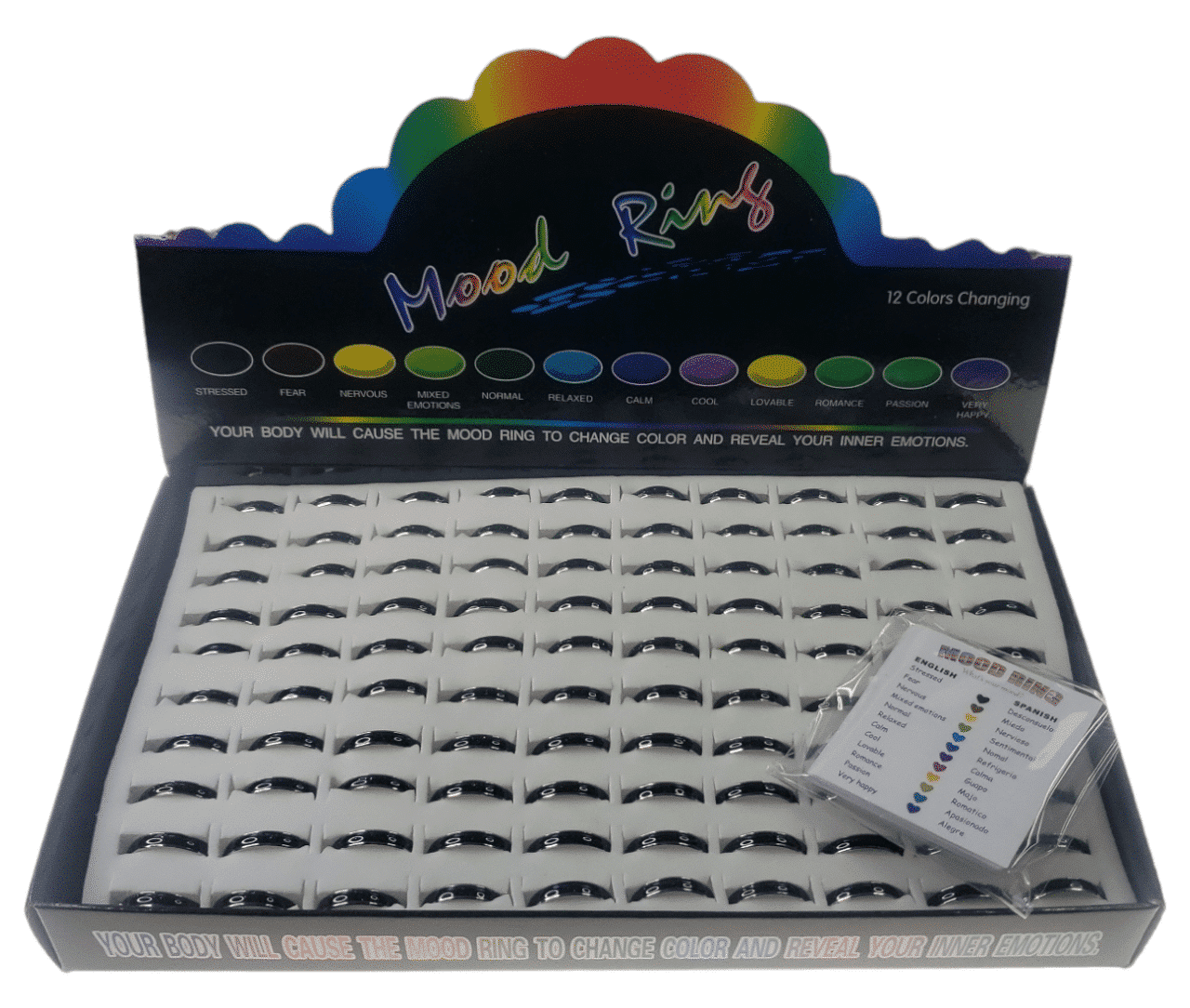
Description
A mood ring is a ring that contains a thermochromic element, such as liquid crystals. The ring changes color in response to the wearer's body temperature. The color is used, by some proponents, to indicate the wearer's emotional state. The mood ring was conceived in 1975 by two New York inventors, Josh Reynolds and Maris Ambats, who combined bonded liquid crystals with quartz stones in rings. They initially sold them at retail for $45 for a "silver ring" and $250 for a gold one. They became increasingly popular in the 1970s. A mood ring is a specialized liquid crystal thermometer, worn on the finger. The ring is usually adorned with a faux gemstone (usually made of quartz or glass) that either has a clear capsule filled with thermochromic liquid crystals or has a thin sheet of liquid crystals sealed underneath. Changes in temperature cause the crystal to emit different wavelengths of light, which changes the stone's color. The liquid crystal used in mood rings is typically designed to reflect a "neutral" color at the average human skin temperature, which is about 37°C (98.4°F). The theory behind the ring's ability to indicate the wearer's mood is based on the claim that body heat fluctuates with the wearer's emotional state. Human body temperature is known to vary by small amounts (less than 0.5°C) during circadian and menstrual cycles, and when the body is fighting an infection. Variations in air temperature appear to have a greater effect on the ring's temperature than changes in the wearer's body temperature. No direct correlation between a particular mood and a specific color has ever been substantiated.


