
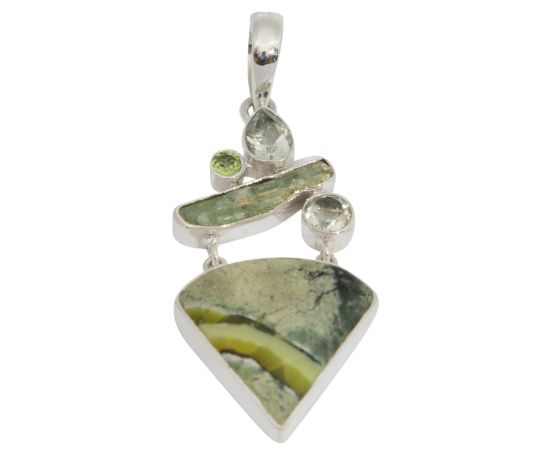
Description
Prasiolite, also called green amethyst, is a highly sought-after gemstone due to its beautiful green color and powerful properties. It transforms negative energy into positive energy and helps restore lost balance. It stimulates creative thinking and the courage to pursue one's heart's desires. This beautiful crystal brings peace and warms the heart. Prasiolite also has a positive effect on the heart and can reduce cardiac arrhythmias.
Prasiolite, green quartz, or vermarine is a green form of quartz, a silicate mineral chemically silicon dioxide. Prasiolite is one of many varieties of quartz. Since 1950, almost all natural prasiolite has come from a small Brazilian mine, but it can also be found in Lower Silesia, Poland. Naturally occurring prasiolite is also found in Thunder Bay, Canada. Quartz is a form of silicon dioxide, SiO2, and is one of the most abundant minerals in the Earth's crust. It represents more than 12% of the Earth's crust by volume (including in granite and sand). Quartz has two modifications: α-quartz is trigonal, and β-quartz (a higher-temperature form) is hexagonal. Silicon dioxide also occurs in many other structures, such as α- and β-cristobalite, keatite, tridymite, coesite, stishovite, melangophlogite, and lechatelierite. Although quartz consists of silicon dioxide, it is often classified as a tectosilicate. This is because quartz forms a network of SiO4 tetrahedra, with each oxygen atom shared by two silicon atoms. Individual SiO2 molecules only occur in gaseous silicon dioxide. Quartz can be very pure, as with rock crystal, but often contains impurities. These impurities can consist of ions that are incorporated into the crystal lattice during crystal growth. Quartz crystals can contain between 13 and 15,000 ppm Al3+, between 9 and 1,400 ppm Na+, between 3 and 300 ppm K+, and traces of Fe3+, Ti4+, P5+, H+, and Li+. The aluminum and iron, in combination with ionizing radiation, are responsible for the color of some quartz varieties. Furthermore, quartz crystals can grow over other minerals, as is the case with rutile quartz. Quartz can form both large crystals and microscopic aggregates. The largest quartz crystals are found at Verloren Farm in Namibia. Quartz crystals up to 20 meters, and possibly 50 meters, and dolomite crystals up to 2 meters are found here. When quartz is melted, it often forms a glass upon rapid cooling because the crystallization process takes a considerable time. Quartz is a piezoelectric material, and the vibrations that can be induced in the crystal lattice are used in electronic devices such as quartz clocks and radios.
The mineral kyanite, or disthene, is an aluminum silicate with the chemical formula Al2SiO5. It belongs to the nesosilicate group. This blue, gray, white, green, or black mineral has perfect cleavage along the crystal plane [100], a white streak color, and a vitreous to pearlescent luster. Its crystal system is triclinic, its average density is 3.61, and its hardness is 4 to 7. Kyanite is neither magnetic nor radioactive. The name of the mineral kyanite is derived from the Greek word kyanos, meaning "blue." Kyanite is a very common mineral found in many rocks. It occurs, among other places, in metamorphosed sedimentary rocks. Along with the other aluminum silicates sillimanite and andalusite, it is also an indicator of the depth and temperature at which a rock has undergone metamorphism. Kyanite is generally stable at temperatures below 650°C and at pressures exceeding 0.3 GPa (gigaPascals). Pressure and temperature are related, requiring a higher temperature (600°C) at high pressures (0.6 GPa) to form sillimanite from kyanite. At pressures below 0.3 GPa, andalusite is the stable aluminum silicate. Gemstone-quality kyanites are found in India, in gemstone deposits in Myanmar, and Korea. In the United States, kyanites are mined in California, Tennessee, Georgia, New Hampshire, and North Carolina. In Africa, kyanite occurs in Kenya and Tanzania; in Europe, in Russia, Switzerland, Austria, and France. Kyanite occurs in the sand fraction of Dutch Quaternary river sediments. In heavy mineral analysis conducted in the Netherlands by the National Geological Survey during the second half of the twentieth century, the mineral is classified in the so-called stable group. In this study, only the name disthene is used.
Opal


