

Description
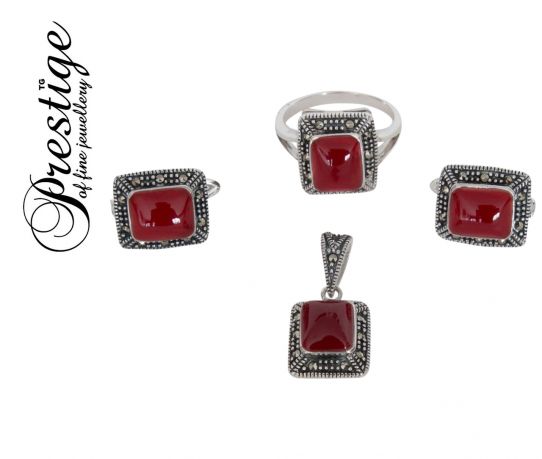
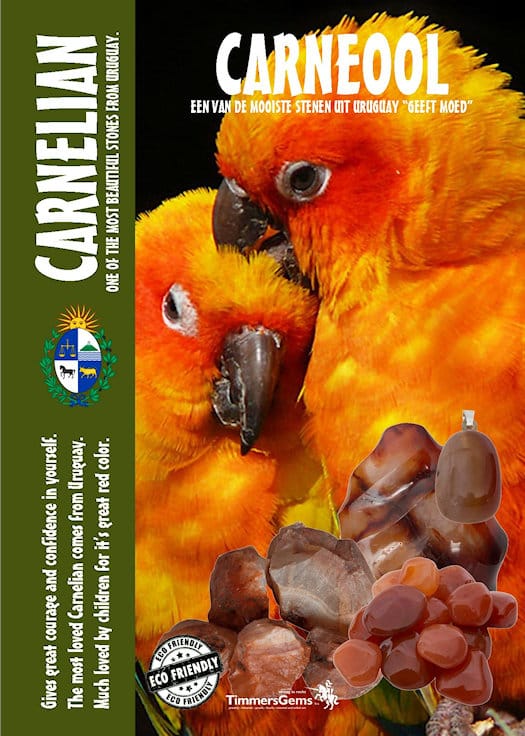
Carnelian is a flesh-red to brown-red, translucent to opaque variety of chalcedony. It belongs to the quartz family. The element that causes the red color is iron, which is present in small impurities within the mineral. Heating can deepen the color. Carnelian is named after the Latin carnis, meaning "flesh." Its old Dutch name is kornalijn (cornelain). Carnelian was used even before the beginning of our era for making seal stones and jewelry. It was said that carnelian offered protection against quarrels, toothaches, and nervous disorders, calmed bleeding, reduced fever, soothed anger, and brought good luck. Carnelian forms in volcanic and weathering zones and is known from India, Saudi Arabia, and Egypt. Important deposits are located in Brazil, the United States, Australia, Russia, the Czech Republic, Germany, and Romania.
The mineral marcasite or spear choose a pale yellow to source tin white iron sulphide with the chemical formula FeS2. The name is derived from the Arabic word Makraschit, the original name for pyrite and similar minerals. Marcasite is rarely recognized as a gemstone, but in the Middle Ages especially popular in France, and was used as folk jewelry. Nowadays, especially in Thailand put small cut marcasites in silver. In prehistoric times it was used as a fire starter in combination with flint. Hydrothermal, postvolcanic, not hyper and sediments. Marcasite has the same chemical formula as the cubic pyrite but a different crystal structure (orthorhombic). This called becomes isomorphic. Marcasite is to the air quickly darkens and copies of this mineral can, over time even crumble or disintegrate. It is unimportant as iron or sulfur ore mineral. In the gems trade name marcasite is used improperly to cut pyrite. This “marcasite” with a brass-yellow color and a high gloss metal is mainly in silver jewelry put the entourage material. The name marcasite is Arabic or Moorish origins. It was used for all pyritic minerals such as marcasite, chalcopyrite, sphalerite and other. Marcasite hydrothermal is usually formed, and is found in sedimentary rocks (such as limestone, shale or lignite), or in veins (with zinc and lead sulphide). The formation of marcasite occurs at low temperatures and under reducing conditions. It is found in the chalk deposits as at Cap Blanc-Nez near Calais, France. Sensitive to heat and sweat, fire comes into sulfur dioxide. The mineral corrodes to the surface.


