

Description
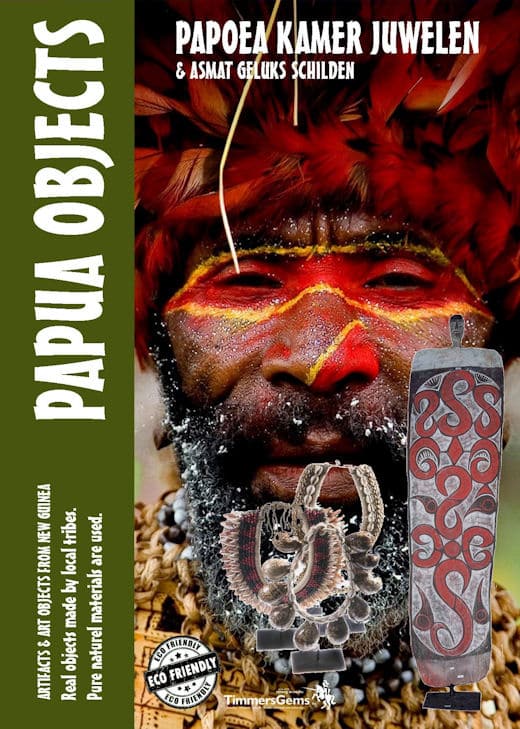
The Papuans are the original inhabitants of the island of New Guinea and several neighboring islands. They live across two countries: Indonesia (the provinces of Papua and West Papua, together known as Irian Jaya before 2000) and Papua New Guinea. In addition, through emigration, Papuans live in the Western world, primarily in the Netherlands. New Guinea is inhabited by nearly a thousand different tribes and speaks an almost equal number of different languages, which are divided into two language groups: a very diverse group of Papuan languages and Austronesian languages. Speakers of Papuan languages, the largest group, live primarily on the island of New Guinea, while speakers of Austronesian languages live primarily on the islands off the north and east coasts of New Guinea and in a narrow coastal strip of New Guinea. Papuans usually refers to speakers of Papuan languages, but sometimes also to the Austronesian-speaking minority. The Austronesian-speaking tribes are also called Melanesians, after Melanesia, of which New Guinea is a part.
Recent evidence shows that Papuans are descendants of the first group of inhabitants to settle on New Guinea. These original inhabitants arrived at a time when the island was connected to the rest of the Australian continent by a land bridge. These people crossed the then-narrower strait from the islands of Wallacea and Sundaland, the present-day Indonesian Archipelago. Archaeological discoveries have shown that the first habitation of the island occurred at least 40,000 years ago, some 10,000 years after the first modern humans left Africa. The ancestors of the Austronesian peoples arrived much later, around 3,500 years ago, as part of the gradual migration of seafaring peoples from Southeast Asia, who may have originated in eastern China. Austronesian-speaking peoples colonized many of the islands off the north and east coasts of New Guinea, such as New Ireland and New Britain, as well as the coast of New Guinea. Inhabitation over tens of thousands of years has resulted in a great diversity of peoples and languages, further enhanced by the arrival of the Austronesians and, in recent history, the colonization of Europeans and Indonesians. The western part of New Guinea was part of the Dutch colony of the Dutch East Indies from the late nineteenth century until Indonesia's independence in 1949. Between 1949 and 1962, it was an overseas territory of the Netherlands, known as Netherlands New Guinea. After six months under the administration of the United Nations (UNTEA), this part of New Guinea was transferred to Indonesia on May 1, 1963. There, it became a province under the name Irian Barat, and from 1970, Irian Jaya. Nuvola single chevron right.svg See also the section Transfer to Indonesia in the article Netherlands New Guinea. Before the transfer to Indonesia, and especially afterward, and to this day, the Papuans have demanded independence from Indonesia, which they regard as the occupying force. From 1965 onwards, it was the Organisasi Papua Merdeka (OPM) (Organization for a Free Papua) that fought for independence from the interior of the Bird's Head Peninsula. On July 1, 1971, the OPM declared the independence of the Republic of West Papua. The armed wing of the OPM ceased to exist around this time, although the OPM is still seen as a symbol of a free Papua. The armed struggle continued, among others, by the Tentara Pembebasan Nasional (TPN) (National Liberation Army) and the Pasukan Pembebasan Nasional (Papenal) (National Liberation Forces), which were primarily active in the border region of Papua New Guinea. The Papuans also pursued independence through diplomatic means, including through the United Nations and the US Congress, continuing to assert their right to self-determination. Papuan representatives meet in the Papuan Congress.


