


Description
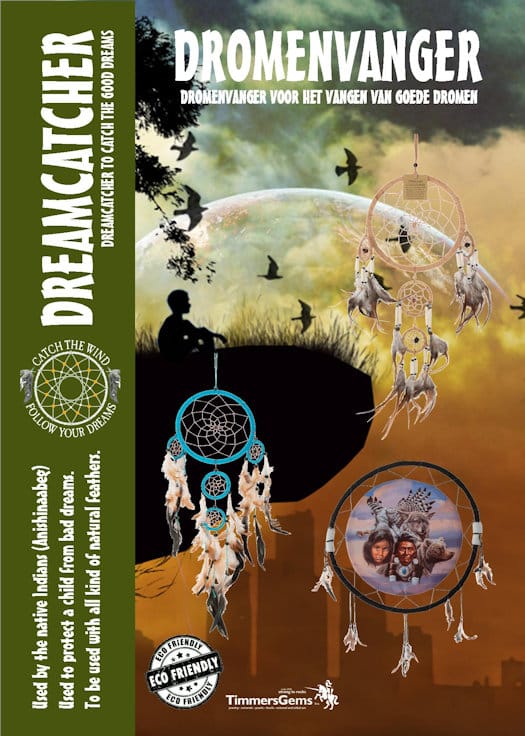
A dream catcher is a traditional object, originally from the Ojibwe (Anishinaabeg), a Native American tribe of North America. Because of its spiritual or esoteric associations, this object also came into use among followers of New Age thought in the late 20th century. A dream catcher consists of a ring (usually made of willow wood) with a web inside it. Beads or stones are often embedded in the web, and feathers hang below the ring. The Ojibwe believe that making and hanging a dream catcher above the bed wards off bad dreams. For centuries, parents have made dream catchers to hang above their children's cribs or carrycots. It is believed that the heavens are saturated with dreams—good dreams, but also bad dreams. During the night, bad dreams are caught in the web, and according to tradition, they slide off in the morning and dry in the morning sun. Good dreams can pass unhindered through the center of the dream catcher and thus enter the life of the dreamer.
Native Americans are the original inhabitants of the Americas. Columbus, who in 1492 believed he had reached the Indies (his intention was to travel westward across the Atlantic Ocean and thus reach the Indies), called the inhabitants indios—Indians. Because the term "Indian" is derived from a Western perspective, several alternative names have come into use. In the United States, the American government and academics introduced the term Native American (Dutch: eigen Amerikaan) in the 1960s for the groups under the responsibility of the Bureau of Indian Affairs. An additional reason was confusion with people of Indian descent, who are also called Indians in English. However, this new terminology was not universally accepted because it was adopted without consultation with those involved and because it conflated Native Americans with the original inhabitants of Alaska, Hawaii, Puerto Rico, and the Pacific Islands. A 2005 survey by the US Census Bureau found that nearly 50% of Native Americans prefer to be called "American Indians," while just over 37% prefer "Native American." Both terms are now used. It is noteworthy that the Bureau of Indian Affairs now uses the term American Indian instead of Native American. The term First Nations/Premières Nations is used in Canada. In Latin America, Native Americans are officially called indígenas (indigenous people). In the scientific world, they are also sometimes referred to as Amerindians or Amerindians. Incidentally, the Eskimos (sometimes called Inuit, although that term does not strictly refer to the Yupik in Alaska) are often (in politics and academia) not considered Native Americans, but are considered "Native Americans." In both Canada and the US, emancipation regarding ethnic naming is increasingly a matter for Indigenous communities themselves, who are becoming increasingly (self-)aware in cultural and political terms. For example, Indigenous peoples officially recognized by the US and Canadian governments, who consider themselves a full-fledged political and cultural state, are increasingly expressing their wish to no longer be called tribes (as in the US) or bands (as in Canada), but rather Nations (nations or states). Furthermore, the names introduced by Europeans (or surrounding Indigenous peoples) in the past are increasingly being replaced by the names peoples gave themselves. For example, instead of Iroquois, people now more often speak of Haudenosaunee. Other name changes include Lakota (Dakota/Nakota) for Sioux, Mexicah for Aztecs, Ñudzahui for Mixtecs, and Mapuche for Araucanians. "Indian" is not capitalized in Dutch because it refers not to a single people but to several ethnic groups (just like Gypsies). King William I, in several of his Royal Decrees, referred to his subjects in the Dutch East Indies as "Indians." However, "Native" became the common term. At the time of Columbus's arrival, North America was divided into several cultural regions. The best known are those of the far north (Arctic region) and those of the prairies in the Midwest, the Great Plains. On the Plains, most people lived along the rivers and were farmers. Farmers also lived in the east and southwest of North America. The main crops were corn, beans, and pumpkins, originally from Mexico. Cotton was also grown in the southwest, and sunflowers, among other crops, were grown in the east. Tobacco was planted in almost the entire present-day United States and southern Canada. The stereotypical image of "the Indian" is based on the Prairie peoples of the nineteenth century. This isn't to say that bison and other animals weren't hunted before Columbus (without horses!). Especially in the northern part of the Great Plains, there were many so-called "Buffalo Jumps." Here, bison were driven into a ravine, where they fell to their deaths. A museum at the Buffalo Jump Head-Smashed-In in Alberta, Canada, demonstrates how this was done.


