
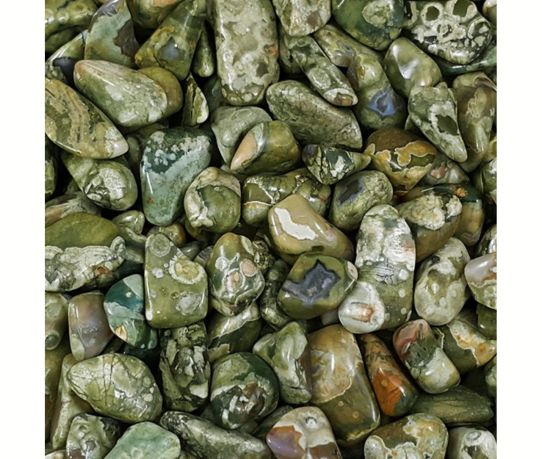
Description
The igneous rock rhyolite or liparite is an effusive rock with a felsic composition, defined as more than 68% silica. The name rhyolite is derived from the Greek rhyx, "lava flow." Rhyolite has small crystals due to the extrusive formation of the rock. In effusive rocks, the magma that reaches the Earth's surface (and is henceforth called lava) cools rapidly to very rapidly, leaving no time for the minerals to develop large crystals. Rhyolite typically consists of the minerals quartz, potassium feldspar, and plagioclase. Traces of more mafic minerals such as biotite, amphibole, and pyroxene may be present in rhyolite. Due to the high silica percentage in rhyolite, the molten rock is very viscous (sticky). As a result, lava flows with a rhyolite composition are much less mobile than the low-viscosity, mafic, and therefore fast-flowing basalts. When rhyolite cools so quickly that it cannot form any crystals at all, it is called a vitrifier, or volcanic glass. The best-known variety is obsidian. Rhyolite occurs wherever highly viscous magma, despite its viscosity, can still reach the Earth's surface and solidify quickly. The deeper varieties of rhyolite are the gangue granophyre and the deep rock granite. Rhyolite, also called koga in Japanese, occurs in hills of the Scottish valley Glen Coe, such as Buachaille Etive Mòr, in Niijima, Japan, and Lipari, Italy. Rhyolite volcanoes also occur on New Zealand's North Island and in Iceland. Due to its mineral composition, rhyolite is often light in color. This color can also vary, from white through pink to light green. When it receives even a glimmer of light, rhyolite casts a very bright color in the landscape, sometimes so bright that it appears to emit light. Beautiful examples of this can be found, among other places, in Landmannalaugar, an area in Iceland.


