
Description
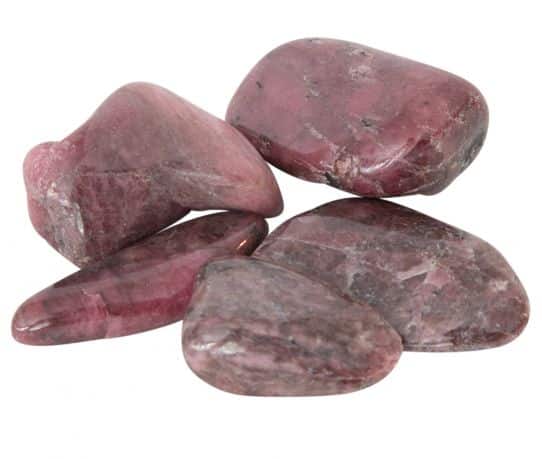
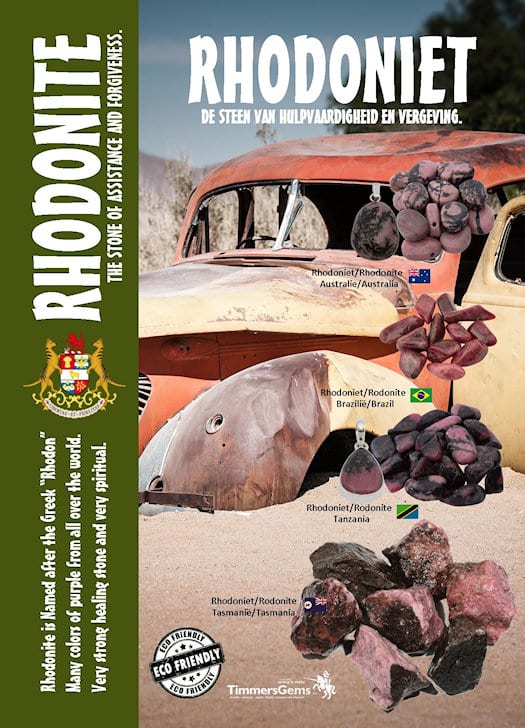
The mineral rhodonite is a manganese-iron-magnesium-calcium silicate with the chemical formula (Mn2+,Fe2+,Mg,Ca)SiO3. The mineral belongs to the inosilicate family. The name rhodonite is derived from the Greek word rhodon, meaning "pink." It has a red base color with black, dendrite-like inclusions of manganese (IV) oxide. Transparent varieties are very rare. Traditionally, rhodonite was attributed with magical powers. It was made into ornaments, vases, and sarcophagi. In the 16th century, rhodonite was considered a stone of happiness and cheerfulness; it cheered the heart, strengthened the spirit, enhanced honor, and improved memory. Rhodonite is found in Alaska, Canada, Brazil (Ouro Preto and Minas Gerais), and Mexico. Very beautiful crystals originate from Peru (Huanzala). In Australia, near Broken Hill, transparent crystals up to 10 cm in size are found, which form the raw material for faceted stones and weigh only a single carat. Other deposits are found in Japan (Honshu), Indonesia, and India. Tanzania (Mwembe), Madagascar, South Africa, and Algeria yield beautiful red crystals. Very important deposits in Russia have been mined since the 18th century. Well-known deposits are in the Urals, where rhodonite crystals weighing 40 tons are found. Smaller deposits exist in Kazakhstan, Uzbekistan, and Ukraine. Very small quantities of rhodonite gemstones are also found in Sweden (Pajsberg and Langban), Spain, and to some extent in Slovakia, the Czech Republic, Germany, Italy, Romania, and France. Rhodonite ornaments are now the pride of numerous museums and treasuries.


