
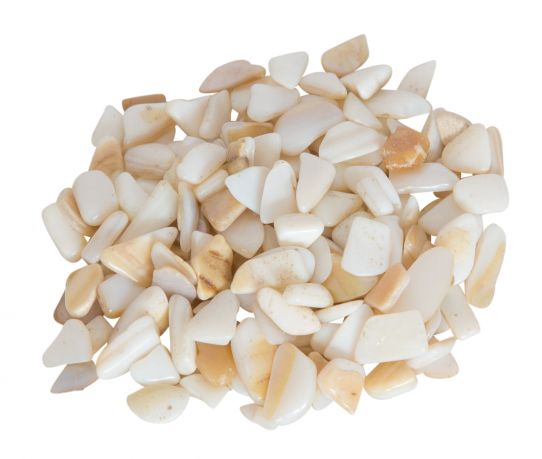


Description
Mother of pearl is a component of the shell of mollusks. Many cultures incorporate the material into utensils or art objects. Almost all shells consist of several superimposed layers, each with its own function, one of which is the mother of pearl layer. The thickness of the various layers varies between mollusk groups. In most groups, the mother of pearl layer is one of the thinner layers that make up the shell; in some, it is (almost) absent; and there are also groups where the shell consists primarily of the mother of pearl layer. The mother of pearl layer is always found on the inside of the shell and is secreted there (like the rest of the shell) by epithelial cells of the animal's mantle tissue. Aside from providing strength, its primary function is to smooth the inside of the shell. A secondary function is to defend the animal against parasites and harmful debris. When the animal is attacked by a parasite or irritated by an external object it cannot expel, a process is initiated that encloses the object in successive layers of nacre. This process can continue uninterrupted until the mollusk dies. Usually, such an object is located between the animal and the shell. In these cases, the shell will only show a thickening at this point: the object is absorbed into the shell itself. Less often, the object is not located in this location, and a completely detached pearl will develop. Nacre is composed of hexagonal aragonite platelets (calcium carbonate (CaCO3)) that are 10 to 20 µm wide and 0.5 µm thick. They are arranged in a continuous, parallel, thin layer. The layers are separated by sheets of organic matrices composed of elastic biopolymers such as chitin, lustrin, and silky proteins. This mixture makes the material strong and resilient, also thanks to the adhesion caused by the "brick structure" of the platelets. This recurring pattern greatly increases the hardness, nearly matching that of silicon. The iridescent appearance of mother-of-pearl is due to the thickness of the aragonite platelets being approximately 0.5 micrometers, which is comparable to the wavelength of visible light. This results in constructive and destructive interference of light at different wavelengths, causing different colors of light to be reflected at different viewing angles.


