
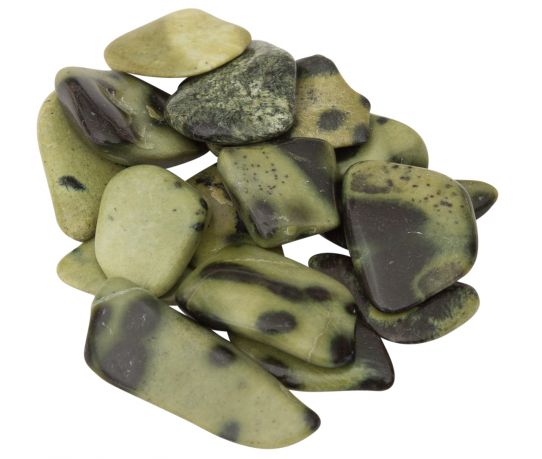
Description
Cheetah is a specific type of serpentine.
The mineral serpentine, or clinochrysotile, is a magnesium-iron silicate with the chemical formula (Mg, Fe)3Si2O5(OH)4. It belongs to the phyllosilicates. The amorphous mineral can be red, yellow, white, and green. The green color is typical of the mineral found in the mantle rock serpentinite. The hardness is 2.5 to 4, depending on the composition, and serpentine has an average density of 2.59. One of these types falls under the category of asbestos. Inhalation of this type is harmful to health. The mineral serpentine, like the rock serpentinite, is named after the Latin word serpens, which means "snake." The shape in which the minerals have grown in the rock is reminiscent of the shape of a snake. It was also formerly used as a remedy for snake bites. The other name for serpentinite, clinochrysotile, is derived from the Greek words clinos, chrysos, and tilos (respectively “crooked, oblique”, “gold”, and “fiber”). It is so named because of the golden-colored fibrous structure that the mineral can assume. Serpentine is an indicative mineral for serpentinite, a peridotite that is often transformed by hydrothermal activity. Under the influence of pressure and temperature, the olivine and pyroxene from the mantle rock have been converted into serpentine. This is known as serpentinization. The chemical reaction equation is: 4Mg2SiO4 (olivine) + 4H2O (l) + 2CO2 (aq) → Mg6Si4O10(OH)8 (serpentine) + 2MgCO3 (magnesite). For this reason, serpentine is a mineral found in those areas where mantle rock has come to the surface, usually in orogens. In Greece and the Alps, serpentine is exposed on a large scale.


