
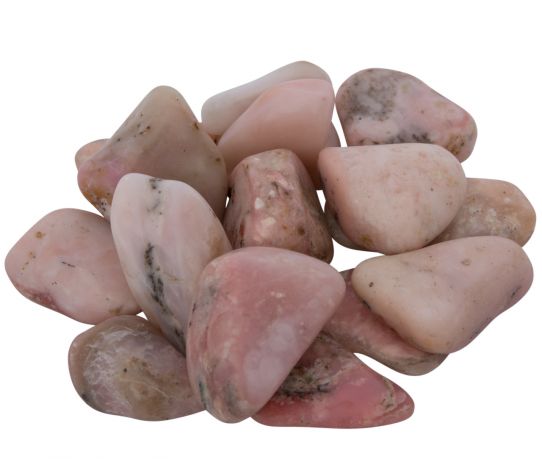
Description
The mineraloid opal is an amorphous variety of quartz, SiO2 nH2O, hydrated silicon dioxide with a water content of up to 20%. Opal can be colorless, white, milky blue, gray, red, yellow, green, brown, and black. Often, many of these colors are immediately visible, caused by the interference and diffraction of light passing through tiny, regularly arranged openings within the opal's microstructure, known as the Bragg lattice. These openings are filled with secondary silica and form thin lamellae within the opal as it hardens. The term opalescence is used to describe this unique and beautiful phenomenon, although play of color would be a more accurate term. Opal is one of the minerals that form or can replace fossils. The resulting fossils are treasured by collectors. "Opal" is derived from the Old Indian word úpala', meaning gemstone. A distinction is made between glittering precious opals, yellow-red fire opals, and common opals. Their physical properties show significant differences. Opal is the official gemstone of South Australia. Opal has been used as a gemstone since ancient times. Initially, it was used to make primitive tools, later for ornamental objects. Opal was already used by the Assyrians, Babylonians, and Romans. Precious opal is among the most mysterious stones. Traditionally, it was considered a stone that brings bad luck, especially for those who did not cleanse it properly. The precious opal described by Pliny comes from the Dubník deposits in Slovakia, which were already being mined at that time. This stone was attributed with magical powers. It helped against melancholy, calmed the nerves, healed the heart, protected against worry, restored vision, and restored brilliance to the eyes. In addition to naturally occurring opal, opal is produced in a variety of ways, both experimentally and commercially. The resulting material can be distinguished from natural opal by its regularity; under magnification, the patches of color are seen arranged in a "lizard skin" or "chicken wire" pattern. Synthetic opals are further distinguished from natural opal by the former's lack of phosphorescence under UV light. Furthermore, synthetic opals are generally lower in density and often highly porous; some can even stick to the tongue. Two notable producers of synthetic opal are Kyocera and Inamori in Japan. Most so-called synthetic opals, however, are more accurately called imitations, as they contain substances not found in natural opal (e.g., plastic stabilizers). The Gilson opals often seen in fine jewelry are actually imitations consisting of laminated glass with scattered bits of foil.


