



Description
The mineral magnetite is an oxide of iron with valences of 2+ and 3+. Its chemical formula is Fe3+2Fe2+O4. Magnetite is a grayish-black, highly magnetic, naturally occurring mineral without cleavage, with an average density of 5.15. Its hardness is 5.5 to 6. The mineral is not radioactive. Its refractive index is 2.42, and the cubic mineral is isotropic. Gray and brown reflections are visible in incident light. Ancient people discovered that magnetite crystals attract or repel each other depending on their orientation. This physical phenomenon is called magnetism. In China, the magnetic properties of magnetite were already being used in the 11th century BC. The terms "magnet," a medieval designation for a magnetic stone, and "magnetite," introduced by Wilhelm Haidinger in 1845, originated from the Latin root "magnet-" (with the nominative "magnes," magnet). Magnetic stones (Ancient Greek: λίθος μάγνης, lithos Magnes) were already known to the Greeks, according to the writings of Theophrastus. The Roman writer Pliny the Elder also mentions a stone called a "lodestone," which is said to have been named after Magnes, a Cretan shepherd who discovered the mineral on Mount Ida. He noticed that the nails in his shoes and the iron head of his staff were attracted to the rock containing the mineral. Pliny distinguished between several types of magnets, primarily between "male" and "female." Only the male magnet possessed the power to attract iron, and was therefore actually magnetite. Female magnets were probably manganese ore, which closely resembles magnetite, or a white mineral later called magnesite MgCO3. However, it is more likely that magnetite was named after Magnesia, a region in Thessaly, or after the city of Magnesia on the Meander, or also after other Greek or Asia Minor cities of the same name, where magnetic chunks of iron ore have been found for more than 2,500 years.
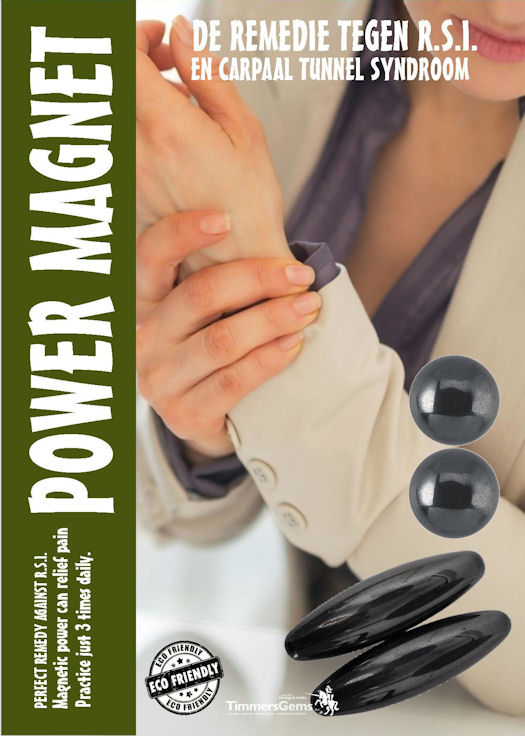
Therefore, it's good for RSI and carpal tunnel syndrome. Use: Place the eggs or massage them onto your skin and body where you feel it's most needed. You can use the eggs several times a day, any day of the week. As a toy: Fantastic as singing eggs; throw both parts into the air, and when they meet again, the whole room will be filled with the sound of a rattlesnake. Warning: Not suitable for children under 5 years old. Be careful with pacemakers and credit cards.
Power magnets
The unique concept of the Timmersgems tubes (displays).
Our unique concept of packaging and display tubes takes the worry out of your hands as a retailer.
We launched this line to meet the growing demand for information leaflets and competitive prices. This new Timmersgems line offers many advantages, which we've summarized below.
1. Competitive prices:
You always get a better price for the item in the tube than if you were to buy it separately.
2. Free brochure:
The tube contains some free extra brochures that you can hand out to your customers.
These contain a wealth of product information that your customers will certainly appreciate.
3. ECO-friendly:
Packaged in a 100% recyclable plastic tube, you'll receive the product without any additional packaging.
No trees are cut down to pack the product in wooden crates, nor do we use fillers such as polyethylene.
4. Beautiful presentation:
You can place the tube directly in the store and it is a great way to show the product to your customers (also as a counter display)


