
Description
Sphalerite points from the Shuikoushan area
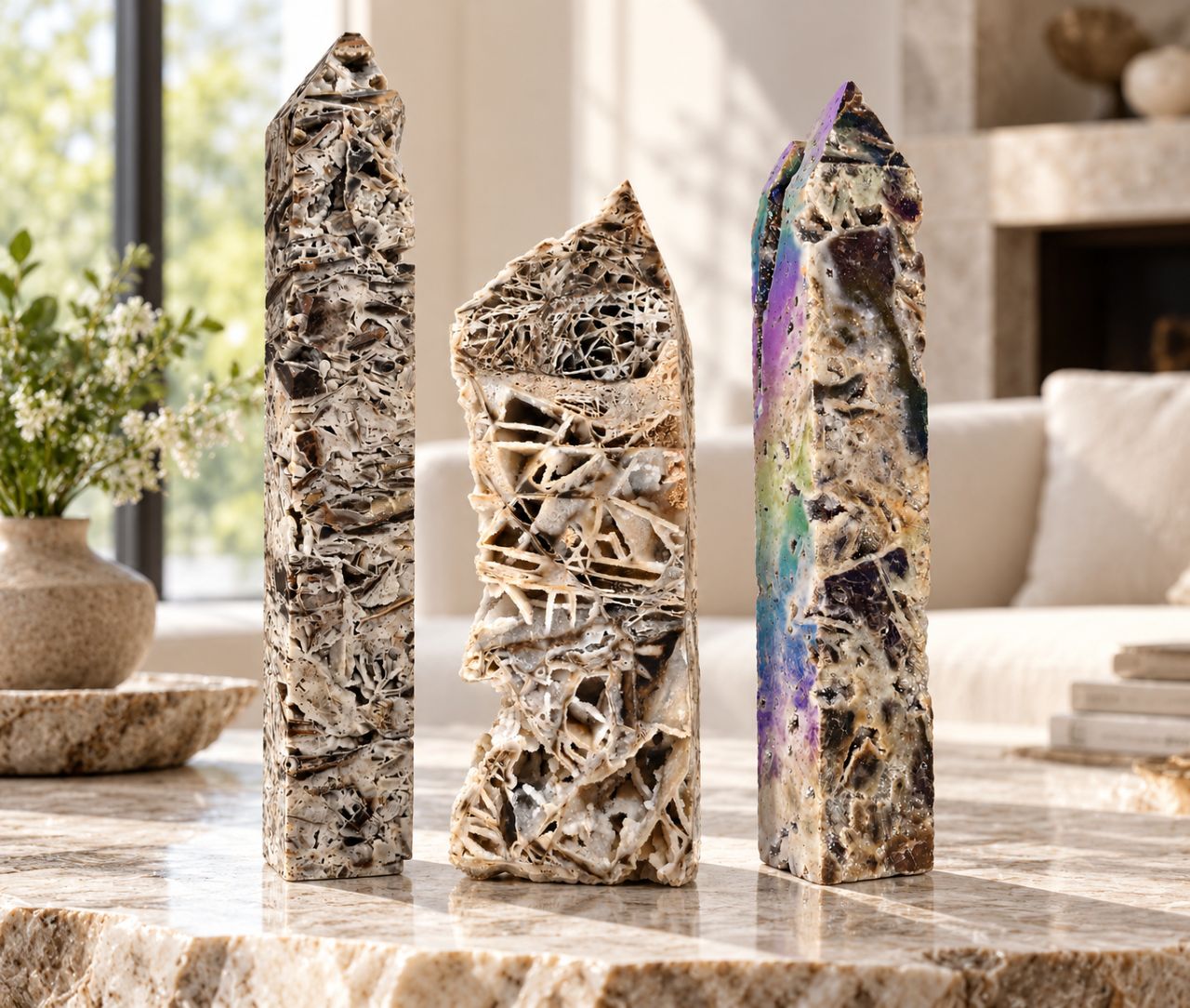
These impressive, polished sphalerite points from the Shuikoushan region in Hunan, China, immediately stand out due to their very special natural structure. The material displays an irregular network of light, grey, brown, and dark mineral particles, with some specimens also exhibiting surprising blue to blue-green spots and reflections . This optical color phenomenon can visually resemble labradorite and is therefore sometimes described as a “labradorite effect,” although mineralogically it is not true labradorescence. With a size of approximately 150 to 300 mm , these are substantial decorative points that are perfectly suited as eye-catchers in a mineral collection or luxury interior.
Originating from the Shuikoushan region in China
The Shuikoushan region in Hunan, China, is known as a historical mining region where zinc, lead, and various accompanying minerals occur, among others. Sphalerite is an important zinc-containing mineral among them and, together with other minerals, can form intricate structures and high-contrast patterns in this area. It is precisely this natural composition that makes the material particularly suitable for large cut decorative points.
A special network of minerals
What primarily distinguishes these points is the complex internal structure. Light mineral zones sometimes form fine veins, web-like patterns, and open structures between dark areas, making each stone look almost like a natural work of art. By sawing, grinding, and polishing the material, these structures become much more clearly visible than in a completely rough specimen.
Sometimes with noticeable bruises
Some specimens display blue, blue-green, or sometimes iridescent color zones. By rotating the point or viewing it from a different angle, the effect can become stronger or more subtle. For collectors, specimens with distinct blue reflections are particularly attractive, as this effect does not occur in the same way in every stone.
Labradorite effect as a comparison
the term “labradorite effect” exclusively to describe the appearance of the blue reflections. In genuine labradorite, the famous play of colors is caused by labradorescence, a specific optical effect associated with the internal structure of the mineral. In the case of these sphalerite points, it concerns a different natural color and reflection phenomenon, but visually the similarity can be striking.
Sharpened to a high decorative point
The natural stone has been carefully shaped into an elongated point with flat, polished sides. This creates a beautiful combination of clean geometric lines and a very irregular internal mineral structure. Under bright daylight or focused display cabinet lighting, the crystalline parts, veins, and any blue color zones become particularly clearly visible.
Size from 150 to 300 mm
With a height of approximately 150 to 300 mm, these sphalerite points are among the larger decorative minerals. A specimen of about 150 mm fits easily in a display cabinet, while the largest points approaching 300 mm can be placed independently as a statement piece on a pedestal, sideboard, or glass table.
Sphalerite as an important zinc mineral
Sphalerite consists primarily of zinc sulfide, ZnS₂, and is the most important ore worldwide for zinc extraction. The mineral can vary greatly in color, luster, and composition and frequently occurs in combination with other minerals. In these cut points, that natural cohesion between different mineral zones is particularly well visible.
Beautiful under focused lighting
These points are shown to their best advantage when light falls on them from the side or rear. The polished surfaces reflect the light, while openings, crystals, and various color zones gain extra depth. For specimens with blue spots, a slight change in the viewing angle may be sufficient to make the color phenomenon more visible.
Special for collectors
For a mineral collector, a large sphalerite point from the Shuikoushan area constitutes a striking collectible in which geology and decorative finish come together. Specimens with a complex web structure, strong contrasts, or a distinct blue light effect, in particular, possess a very distinctive appearance.
Each copy is unique
Because these points are manufactured from natural mineral material, color, crystal structure, veins, openings, inclusions, and any blue reflections from one specimen to another. The exact shape and height also vary within the range of 150 to 300 mm, meaning that no two points are completely identical.
Traditional meaning of sphalerite
Within modern spiritual gemstone traditions, sphalerite is sometimes associated with grounding, concentration, energy, and balance. These meanings are based on personal and spiritual beliefs and have not been scientifically proven to have medical effects.
Features
- Product: large ground sphalerite point
- Mineral: sphalerite with natural accompanying mineral structures
- Origin: Shuikoushan region, Hunan, China
- Chemical composition of Sphalerite: primarily ZnS
- Size: approximately 150 to 300 mm
- Finish: sawn, ground and polished
- Shape: high decorative point
- Color: cream, beige, gray, brown and dark natural zones
- Special effect: sometimes blue to blue-green reflections
- Lighting effect: visually labradorite-like, not true labradorescence
- Use: display cabinet, sideboard, shop display, or mineral collection
- Special feature: irregular web-like mineral structure
- Unique character: every point differs significantly in pattern, color, and light effect
Buy sphalerite point from Shuikoushan
If you are looking for a special sphalerite point from the Shuikoushan region in China, these large specimens of approximately 150 to 300 mm real eye-catchers. The striking natural structures, the polished point shape, and the sometimes present blue reflections with a labradorite-like effect make each piece a unique mineral object for collectors, interior displays, and luxury mineral shops.


