
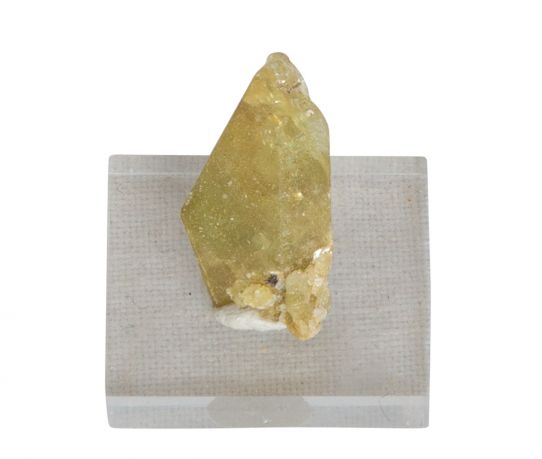
Description
The mineral titanite, or sphene, is a fluorine-containing calcium-titanium silicate with the chemical formula CaTiSiO5. Rare earth elements such as lanthanum, cerium, praseodymium, samarium, and neodymium occur in small quantities in the mineral. The mineral belongs to the nesosilicate family. Gray, green, yellow, red, or reddish-brown titanite has a diamond luster, a reddish-white streak color, and the mineral's cleavage is distinct according to the crystal plane [110] and imperfect according to [100] and [112]. The crystal system is monoclinic. Humite has an average density of 3.48, a hardness of 5 to 5.5, and the mineral is mildly radioactive due to the inclusions of rare earth elements. Its gamma ray value, according to the American Petroleum Institute, is 3805.77. The mineral titanite is a common mineral in felsic particulate rocks, pegmatites, gneisses, schists, and skarns. The type locality is Passau, Bavaria, Germany. Titanite occurs in the sand fraction of Dutch Quaternary river sediments. In the heavy mineral analysis conducted in the Netherlands by the National Geological Survey during the second half of the twentieth century, the mineral is classified in the so-called unstable group. It is considered a volcanic mineral. Several varieties are distinguished, one of which is characteristic of Meuse sands


