
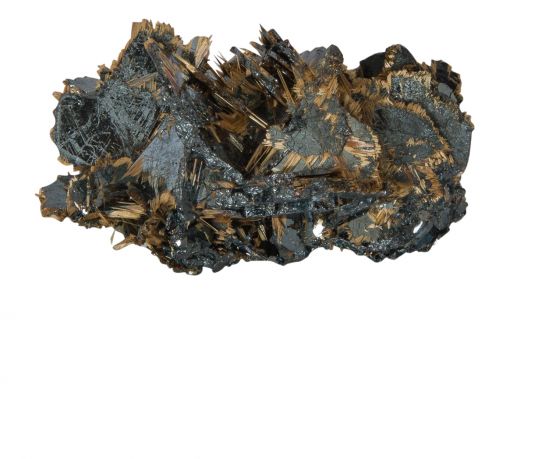
Description
(Rutile) Rutilated quartz is a variety of quartz. The color varies from white transparent rock crystal to dark gray or dark brown smoky quartz filled with silvery, gold-colored, or reddish to red rutile needles. Chemical composition: SiO2 + TiO2 (rutile) + Fe, Sn, V, Cr, Nb, Ta + (Na, K, Cl, C) Crystal system: quartz is trigonal, rutile is tetragonal. Crystal class: oxides. Cleavage: indistinct. Color: dark pink to very light, transparent pink. Streak color: white. Luster: vitreous Fracture: rough, conch-shaped. Hardness (Mohs): 7. Average density: 2.68 – 2.72. Transparency: transparent to translucent. A common mineral. Localities include Switzerland, Brazil, Madagascar, the USA, and Australia. The rutile needles were mistaken for the hair of Venus, giving the crystal the nickname Venus's hair quartz or sagenite. This was said to be a powerful love amulet. Later, it was believed that this mineral contained angel hair, and it was given the name angel hair quartz. Rutilated quartz is associated with the zodiac signs Leo and Aries.
Gemstone therapy Rutilated quartz
One of the iron oxides. It occurs alongside other varieties such as red bloodstone and gray-black to black iron luster and micaceous iron. The mineral has a hardness between 5 and 6. The so-called streak, or streak color, the color the mineral releases when rubbed over an unglazed porcelain dish, is usually a characteristic blood red – hence the mineral's name. The mineral may contain traces of magnesium, manganese, and titanium. Hematite occurs both as a gangue mineral and in sedimentary layers. It is often the cause of the red coloration of many rocks. Other iron ores such as magnetite, limonite, and iron spar often occur alongside hematite. When magnetite has been converted to hematite, it is called martite. The mineral is found worldwide, in Europe in Germany, including in the Lahn region, where the world's largest concentration of iron ores is located, in the Eifel, the Harz mountains, and in the Thuringian Forest. It also occurs in England in Cumberland and North Lancashire, in Belgium in Vezin and Namur, on the Italian island of Elba, and in Spain. In Africa, Algeria is a notable producer, and in the United States, it is found near Upper Lake and the Missouri River. More than half of the world's production currently comes from China, Brazil, and Australia. The mineral also occurs in high concentrations on the surface of Mars, giving the "Red Planet" its characteristic orange-red color. In its pure state, hematite consists of 70% iron, making it the most important iron ore. Iron is extracted by reacting it with carbon at high temperatures. Hematite is also used as a polishing agent and, due to its high reflectivity, has long been used as a mirror. The red color and the fact that hematite is non-toxic make the mineral very suitable as a pigment. It was already used in the Stone Age for rock carvings and body painting. Artists use pressed hematite pencils for drawings and sketches. Such pencils are soft and color well. Red bolus, a highly clay-containing hematite, is often used as a base coat for gilding. As a pigment, hematite is suitable for painting ceramics and dyeing threads for carpets.


