
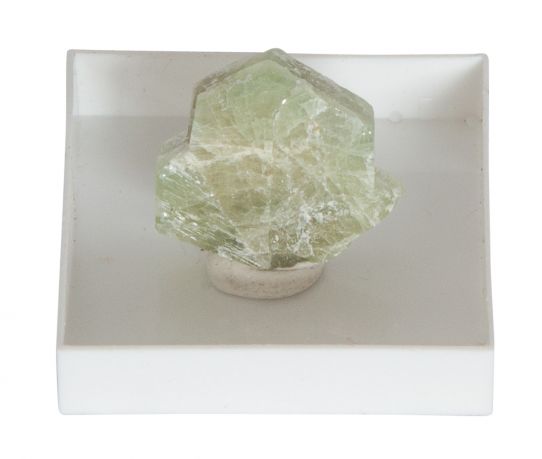
Description
Chrysoberyl is so named because of its resemblance to beryl, which in Greek means chrysos or gold. The mineral is predominantly golden yellow in color with green and honey-brown highlights. Chrysoberyl is a beryllium-aluminum oxide with the chemical formula BeAl2O4. With a Mohs hardness of 8.5, chrysoberyl is one of the hardest minerals. Only diamond and corundum (ruby and sapphire) are harder. Historically, chrysoberyl was considered beryl. The stone is used in jewelry. The cymophane variety is highly prized. Chrysoberyl crystals form in igneous rocks. It is usually found as flat, rounded stones in alluvial deposits, for example, in Brazil and Sri Lanka. Chrysoberyl has also been found in Madagascar, Zimbabwe, Russia, India, Myanmar, and Italy. Alexandrite is a green variety of chrysoberyl that turns red in artificial light. The unusual color of alexandrite is caused by the presence of chromium. In cymophane, the fine parallel hollow channels create a silvery white streak when illuminated by light, resembling a cat's eye. This variety is therefore also known as cat's eye. Despite its great hardness, chrysoberyl has few practical applications. It is primarily used for jewelry making. The brightest varieties of chrysoberyl are extremely valuable.


