
Description
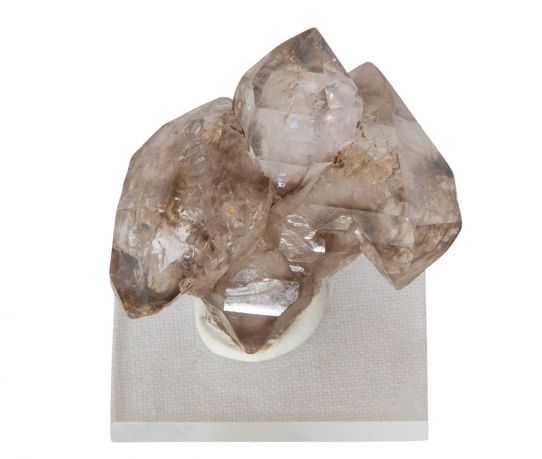
Elestial is the quintessential New Age crystal; so-called "Lightworkers" often feel particularly drawn to these crystals. Elestials are master healers and can be considered the kings and queens of the crystal world. Because this type of crystal often exhibits overlapping layers, it is also called skeleton quartz or crocodile quartz (due to its resemblance to the geometric patterns on a crocodile's skin). This crystal can be "read" by running your fingertips over the layers. Containing ancient knowledge and profound wisdom, the energy of this crystal works on many levels simultaneously and is capable of uncovering dark, buried thoughts and old pain. So beware! Do not purchase an elestial if you are not willing to face your own repressions/shadows! An elestial helps resolve emotional problems, removes blockages and fears, and brings balance. It has a strong effect on the pineal gland. On a physical level, elestial has a cleansing effect. Waste products are removed from the organs and returned to the bloodstream. It is important to drink plenty of water to ensure the toxins are properly eliminated.
Elestial quartz.
Amethyst is a violet variety of the mineral quartz (SiO2) and is the most sought-after stone of the quartz group. Etymology: The name derives from the Greek αμεθυστoς (amethystos). Amethyst was already known to the Egyptians, Etruscans, and Romans, and was described by Pliny the Elder. In ancient China, small gems were cut from amethyst. In the Middle Ages, amethyst was also highly prized in Europe. It was called the bishop's stone because it was once a favored gemstone for ecclesiastical dignitaries and was believed to possess magical powers. It was the symbol of lovers, the stone of temperance, a protector against sorcery and witchcraft. Jacob van Maerlant offers an explanation that the stone dispels drunkenness. It has been assumed that the Greek name meant "against intoxication": wine drunk from a cup made of amethyst was said to prevent one from becoming drunk. Origin: Metamorphic, hydrothermal, alluvial deposits. The crystals always grow on a substrate; the prisms are often weakly developed, and therefore the crystal points of amethyst predominate; here, the color is also most intense. These parts are knocked off, that is, broken off for further use. Firing at temperatures between 470 and 750 degrees Celsius produces light yellow, reddish-brown, green, or colorless varieties. Some amethysts gradually fade in daylight. Radium irradiation can restore the original color. The color is caused by iron combined with ionizing radiation. Amethyst is less attractive in artificial light. Occurrence: As early as the Middle Ages, Brazil boasted its amethyst deposits; they are mined in places including Bahia, Minas Gerais, and Mato Grosso. Recently, the so-called ametrine, an amethyst-citrine, has been mined in Bolivia, where the violet and yellow colors alternate, but the transition between the colors is sharply defined. Amethysts are also known in the United States, namely in Montana, Maine, Georgia, and Arizona. Canada, Mexico, Bolivia, India, Myanmar, Japan, China, and Korea, as well as Sri Lanka, Zimbabwe, Congo, and Australia, are also important producers. In Russia, amethyst is found in the Urals, Yakutsk, and the Kola Peninsula, among other places. Amethysts are also found in Armenia, Germany, the Czech Republic, Slovakia, Bulgaria, Switzerland, and Ireland. Amethyst rarely forms larger, pure crystals. The British Museum houses a unique cut stone weighing 343 carats. Other, smaller stones weigh less; they usually come from Brazil. The Smithsonian Institution in Washington, DC, even possesses a cut amethyst from Brazil weighing 1,362 carats and one from North Carolina weighing 202.5 carats. Amethysts were often used in state jewels, such as Catherine the Great's scepter and the scepter of the British Crown.
Searching for Amethyst and opening the geodes.


