


Description
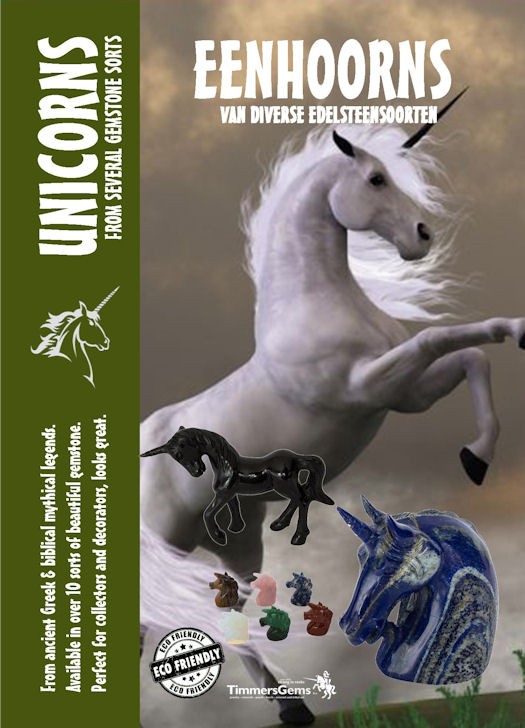
A unicorn is a mythical animal described since antiquity as a beast with a long, pointed, spiraling horn on its forehead. The unicorn was depicted on ancient seals from the Indus Valley Civilization and mentioned by ancient Greek authors such as Ctesias, Strabo, Pliny the Younger, and Claudius Aelianus. The Bible also describes an animal, the re'em (probably a wild bull or aurochs), which in some translations was incorrectly rendered as "unicorn." In European folk culture, the unicorn was often depicted as a white, horse- or goat-like animal with a long horn and cloven hooves (sometimes with a goatee). In the Middle Ages and Renaissance, it was commonly characterized as a very wild animal of the forests, a symbol of purity and grace, that could only be captured by a virgin. Its horn was believed to purify poisoned water and cure disease. In those centuries, the tooth of a narwhal (a type of whale) was sometimes sold as unicorn horn. The ancient Indian myth of the hermit Gazellenhorn tells of Rsyasrnga (or Ekasrnga, literally "unicorn"). This Rsyasrnga is the son of a goddess in the form of a gazelle, and therefore has a horn on his head. He was brought to the palace by an attractive courtesan to end a period of drought. In 398 BC, the unicorn was described in considerable detail by the Greek physician and historian Ctesias, who heard about it at the court of the Persian king through accounts from travelers from India. The Indian wild asses, Ctesias recounted in Indika, were as large as horses and sometimes larger. Their bodies were white, their heads purple, and their eyes blue. On their foreheads, they had a sharp horn that was white at the base, red at the top, and black in the center. In India and China, the unicorn was already mentioned before then. The Roman Pliny the Elder also described the animal.
The crystal skulls are works of art cut from quartz or rock crystal, shaped like human skulls. They surfaced in the second half of the nineteenth century and were originally attributed to various pre-Columbian civilizations. Research in the 1990s, using tools including a scanning tunneling microscope, showed that at least some of these skulls are forgeries. They were made with grinding instruments that were only developed in the second half of the nineteenth century. There is a strong suspicion that several of the crystal skulls were commissioned by the French dealer Eugène Boban and sold by him. One of the most famous skulls is the Mitchell-Hedges skull. It was said to have been found by the British adventurer F.A. Mitchell-Hedges in a chamber beneath the ruins of Lubaantun in Belize. He later discovered that he had purchased this skull privately at Sotheby's in London. His wife explained that he had only given the skull as collateral and had bought it back through Sotheby's. After Anna Mitchell-Hedges' death, the skull came into the possession of Bill Homann. In the 1990s, it was discovered that the Mitchell-Hedges skull was also a forgery. Since then, numerous hypes and legends have arisen surrounding the crystal skulls. Because of their supposed discovery, they were said to have been created centuries ago by the Mayans, the Aztecs, or an even older pre-Columbian civilization. They were also said to possess paranormal powers and should never be looked directly into their eyes. Another legend claims they have extraterrestrial origins. Thirteen of them are said to exist on Earth. Once reunited, they are said to share their knowledge with humanity. Even today, the skulls still play a role in some parts of the New Age community.
In fiction:
• In the 2008 film Indiana Jones and the Kingdom of the Crystal Skull, all the above legends are combined.
• The Hidden Crystal, a book by Manda Scott, deals with the crystal skulls and the Mayan 2012 phenomenon.
• In the 21st episode of season 3 of the 2000 science fiction series Stargate SG-1 (Crystal Skull), Daniel Jackson disappears when he looks into a crystal skull.
• The Assassin's Creed series refers to the skulls, where they are ancient artifacts with mysterious powers.
Gemstone skulls. Gemstone skulls have been popular and mysterious for many cultures for decades. The skulls have a wide variety of meanings. Celtic skulls symbolize Time, Power, creation, initiation, and concentration. Celtic culture believes the skull is a seat of power and strength. Some texts refer to the skull as the seat of our soul. Archaeological discoveries teach us that the ancient Celts offered skulls to sacred sources. The skull is universally seen as a symbol of life and death. More recently, the skull has been linked to death and embracing our mortality. In times long past, the skull sometimes represented life. Skulls and skeletons are the symbol of the Mexican holiday, the Day of the Dead. The skull and crossbones is a popular symbol for pirates and poison. Some healers use skulls to see visions of the present, past, and future. Other materials used include rose quartz, rock crystal, rhodonite, aventurine, and hematite.
The mystery of the skulls


