
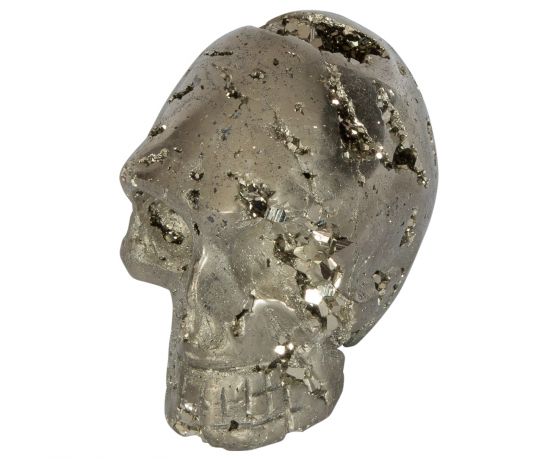
Description
Pyrite, or iron pyrite, is a mineral with the formula FeS2 (chemical name: iron disulfide). It is an important ore of iron and sulfur. It often forms well-formed (euhedral) crystals in the shape of a cube with characteristic striations and a golden sheen. It is also called tinsel or fool's gold (from the English word "fool's gold") because it was sometimes mistaken for gold. The name "cat's gold" is also sometimes incorrectly used, but this refers to yellow mica or resin. Because pyrite is abundant, it can create the illusion of great wealth. However, pyrite is not very valuable (although it can be sold). It is found with other sulfur-bearing minerals, but also with oxides, in quartz veins, in sedimentary rocks in coal beds, and as a replacement mineral in fossils. Pyrite is a disulfide with sulfur pairs (S2)2- and Fe2+ ions in an octahedral environment in a t2g6 low-spin state. Because both ions have a closed configuration, it is a diamagnetic semiconductor. Weathering of pyrite produces iron (hydr)oxides, which also release sulfuric acid. This acid can then react with other minerals, leading to the formation of minerals such as gypsum, alunite, and jarosite. A major source of pyrite is the island of Elba. The name pyrite is very old, derived from the old Indo-European word pyr (fire, cf., for example, pyrotechnics for fireworks art), or the English word pyre (burning pyre), because one could make sparks by striking pyrite against flint or iron. Today, we understand flint to mean something completely different (a specific form of SiO2). Other names one may encounter for pyrite are ferrous sulfide, ferrous sulfide, and the less common words ironblende and iron oxide. Pyrite was once sold as imitation gold because of its golden sheen. However, the sheen changes when the surface is tilted, while gold's sheen remains the same. Pyrite is also angular, with sharp edges, and hard, while gold is round and soft.
The crystal skulls are works of art carved from quartz or rock crystal in the shape of human skulls. These appeared in the second half of the nineteenth century and were originally attributed to various pre-Columbian civilizations. Research in the 1990s, using a scanning tunneling microscope among other methods, showed that at least a number of these skulls are forgeries. These were made with grinding tools that were not developed until the second half of the nineteenth century. There is a strong suspicion that a number of the crystal skulls were manufactured on commission for the French merchant Eugène Boban and sold by him. One of the most famous skulls is the Mitchell-Hedges skull. It is said to have been found by the British adventurer F.A. Mitchell-Hedges in a chamber beneath the ruins of Lubaantun in Belize. It later emerged that he had purchased this skull privately at the London auction house Sotheby's. His wife gave the reason that he had merely given the skull to someone as collateral and had bought it back through Sotheby's. After the death of Anna Mitchell-Hedges, the skull came into the possession of Bill Homann. In the 1990s, it turned out that the Mitchell-Hedges skull was also a fake. In the meantime, numerous hypes and legends have arisen surrounding the crystal skulls. Due to their supposed discovery site, they were allegedly manufactured centuries ago by the Mayans, the Aztecs, or an even older pre-Columbian civilization. They were also said to possess paranormal abilities, and one should never look them directly in the eyes. According to another legend, they have an extraterrestrial origin. Thirteen of them are said to be found on Earth. Once reunited, they would share their knowledge with humanity. Even today, the skulls still play a role within a part of the New Age community.
In fiction:
• In the 2008 film Indiana Jones and the Kingdom of the Crystal Skull, all the above legends are combined.
• The Hidden Crystal, a book by Manda Scott, deals with the crystal skulls and the Mayan 2012 phenomenon.
• In the 21st episode of season 3 of the science fiction series Stargate SG-1 from 2000 (Crystal Skull), Daniel Jackson disappears when he looks into a crystal skull.
•The Assassin's Creed series references the skulls, where they are ancient artifacts with mysterious powers.
Gemstone skulls. Gemstone skulls have been popular and mysterious for many cultures for decades. The skulls have a wide variety of meanings. Celtic skulls symbolize Time, Power, creation, initiation, and concentration. Celtic culture believes the skull is a seat of power and strength. Some texts refer to the skull as the seat of our soul. Archaeological discoveries teach us that the ancient Celts offered skulls to sacred sources. The skull is universally seen as a symbol of life and death. More recently, the skull has been linked to death and embracing our mortality. In times long past, the skull sometimes represented life. Skulls and skeletons are the symbol of the Mexican holiday, the Day of the Dead. The skull and crossbones is a popular symbol for pirates and poison. Some healers use skulls to see visions of the present, past, and future. Other materials used include rose quartz, rock crystal, rhodonite, aventurine, and hematite.


