
Description
The crystal skulls are works of art cut from quartz or rock crystal, shaped like human skulls. They surfaced in the second half of the nineteenth century and were originally attributed to various pre-Columbian civilizations. Research in the 1990s, using tools including a scanning tunneling microscope, showed that at least some of these skulls are forgeries. They were made with grinding instruments that were only developed in the second half of the nineteenth century. There is a strong suspicion that several of the crystal skulls were commissioned by the French dealer Eugène Boban and sold by him. One of the most famous skulls is the Mitchell-Hedges skull. It was said to have been found by the British adventurer F.A. Mitchell-Hedges in a chamber beneath the ruins of Lubaantun in Belize. He later discovered that he had purchased this skull privately at Sotheby's in London. His wife explained that he had only given the skull as collateral and had bought it back through Sotheby's. After Anna Mitchell-Hedges' death, the skull came into the possession of Bill Homann. In the 1990s, it was discovered that the Mitchell-Hedges skull was also a forgery. Since then, numerous hypes and legends have arisen surrounding the crystal skulls. Because of their supposed discovery, they were said to have been created centuries ago by the Mayans, the Aztecs, or an even older pre-Columbian civilization. They were also said to possess paranormal powers and should never be looked directly into their eyes. Another legend claims they have extraterrestrial origins. Thirteen of them are said to exist on Earth. Once reunited, they are said to share their knowledge with humanity. Even today, the skulls still play a role in some parts of the New Age community.
In fiction:
• In the 2008 film Indiana Jones and the Kingdom of the Crystal Skull, all the above legends are combined.
• The Hidden Crystal, a book by Manda Scott, deals with the crystal skulls and the Mayan 2012 phenomenon.
• In the 21st episode of season 3 of the 2000 science fiction series Stargate SG-1 (Crystal Skull), Daniel Jackson disappears when he looks into a crystal skull.
• The Assassin's Creed series refers to the skulls, where they are ancient artifacts with mysterious powers.
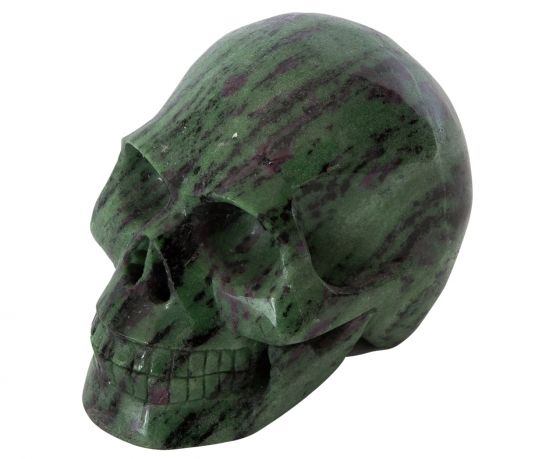
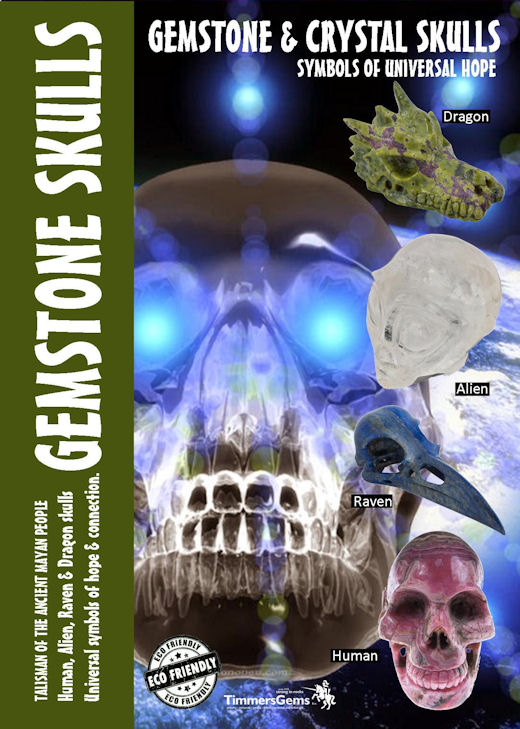
Gemstone skulls. Gemstone skulls have been popular and mysterious for many cultures for decades. The skulls have a wide variety of meanings. Celtic skulls symbolize Time, Power, creation, initiation, and concentration. Celtic culture believes the skull is a seat of power and strength. Some texts refer to the skull as the seat of our soul. Archaeological discoveries teach us that the ancient Celts offered skulls to sacred sources. The skull is universally seen as a symbol of life and death. More recently, the skull has been linked to death and embracing our mortality. In times long past, the skull sometimes represented life. Skulls and skeletons are the symbol of the Mexican holiday, the Day of the Dead. The skull and crossbones is a popular symbol for pirates and poison. Some healers use skulls to see visions of the present, past, and future. Other materials used include rose quartz, rock crystal, rhodonite, aventurine, and hematite.
The mystery of the skulls
The ruby (derived from the Latin ruber, "red") is a red gemstone, a variety of the mineral corundum, whose color is primarily due to chromium. Natural rubies are exceptionally rare, while artificially produced specimens are relatively inexpensive. Besides the bright gemstone ruby, there is also the less bright semi-precious stone of the same name. This stone has been prized since antiquity. The oldest written sources on ruby mining mention quarries in Burma. From there, the stones were transported via trade routes to the courts and temples of the ancient Egyptians and Greeks. In the Middle Ages, rubies were also prized in Rome. Initially, they were cut into an oval shape. These very large and beautiful stones also have their own names. The ruby was considered the stone of life, which strengthens the heart and restores strength. In antiquity and the Middle Ages, rubies were attributed magical powers. The Bible also recognizes the value of the ruby, although some passages specifically point to the existence of treasures of greater value: wisdom is more precious than rubies (Proverbs 3:15), and the value of a good wife far surpasses that of rubies in the eyes of her husband (Proverbs 31). Job 28 also mentions the ruby as one of the treasures people seek in places where the priceless and unfindable wisdom of the living God cannot be found. It should be noted, however, that what is sometimes identified as a 'ruby' in the Statenvertaling (State Translation), appears under entirely different names in some other translations. This interpretation should take into account what was considered valuable in the culture and time period when the translation in question was written. The ruby also has a mythological significance. The ruby is one of the "nine precious stones" in the Thai Order of the Nine Gems. Rubies are mined in Africa, Asia, and Australia. They are most commonly found in Burma, Sri Lanka, and Thailand, although they have also been found in Montana and South Carolina. Rubies have a hardness of 9 on the Mohs scale of hardness, and among natural gemstones, they are surpassed only by diamonds. Other varieties of corundum are called sapphires. Ruby-red semi-precious stones are valued according to various characteristics, such as size, color, clarity, and cut. All natural rubies have imperfections, and only artificial rubies can be completely free of imperfections. The fewer and less noticeable the imperfections, the more valuable the ruby, unless there are no imperfections at all (i.e., a "perfect" ruby). In that case, it could be an artificial ruby. Some artificial rubies have additives added to them so they can be identified as artificial, but most require the services of a specialized appraiser to determine their precise value.
Ruby mines in Myanmar


