
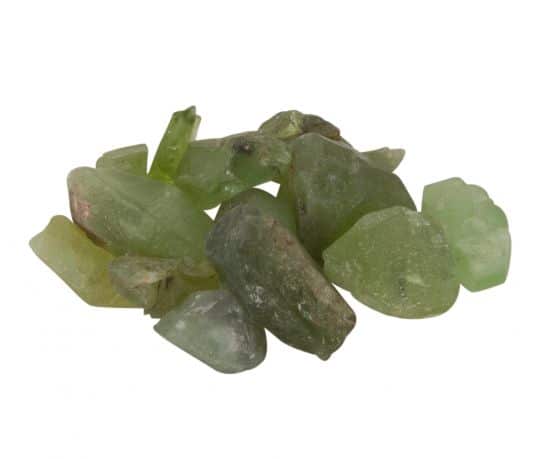
Description
The mineral group epidote consists of a number of sorosilicates, the most important of which is the mineral epidote. The mineral epidote is a calcium-iron-aluminum silicate with the chemical formula Ca2(Fe3+,Al)Al2(SiO4)(Si2O7)O(OH). Yellowish- to brownish-green, gray, or black epidote has a vitreous luster, a grayish-white streak color, and perfect cleavage according to crystal plane [001]. The crystal system is monoclinic. The average density is 3.45 and the hardness is 7. Epidote is not radioactive. The name epidote is derived from the Greek epidosis, meaning "addition." Epidote is a very common mineral worldwide, especially in contact metamorphic rocks. It is formed in crystalline limestone and schists. Beautiful epidote crystals are found particularly in the Knappenwand, near the Grossvenediger in the Untersulzbachthal, Salzburg (Austria). Epidote is common in the sand fraction of Dutch Quaternary river sediments. In the heavy mineral analysis conducted in the Netherlands by the National Geological Survey during the second half of the twentieth century, the mineral is classified in the so-called unstable group.


