
Description
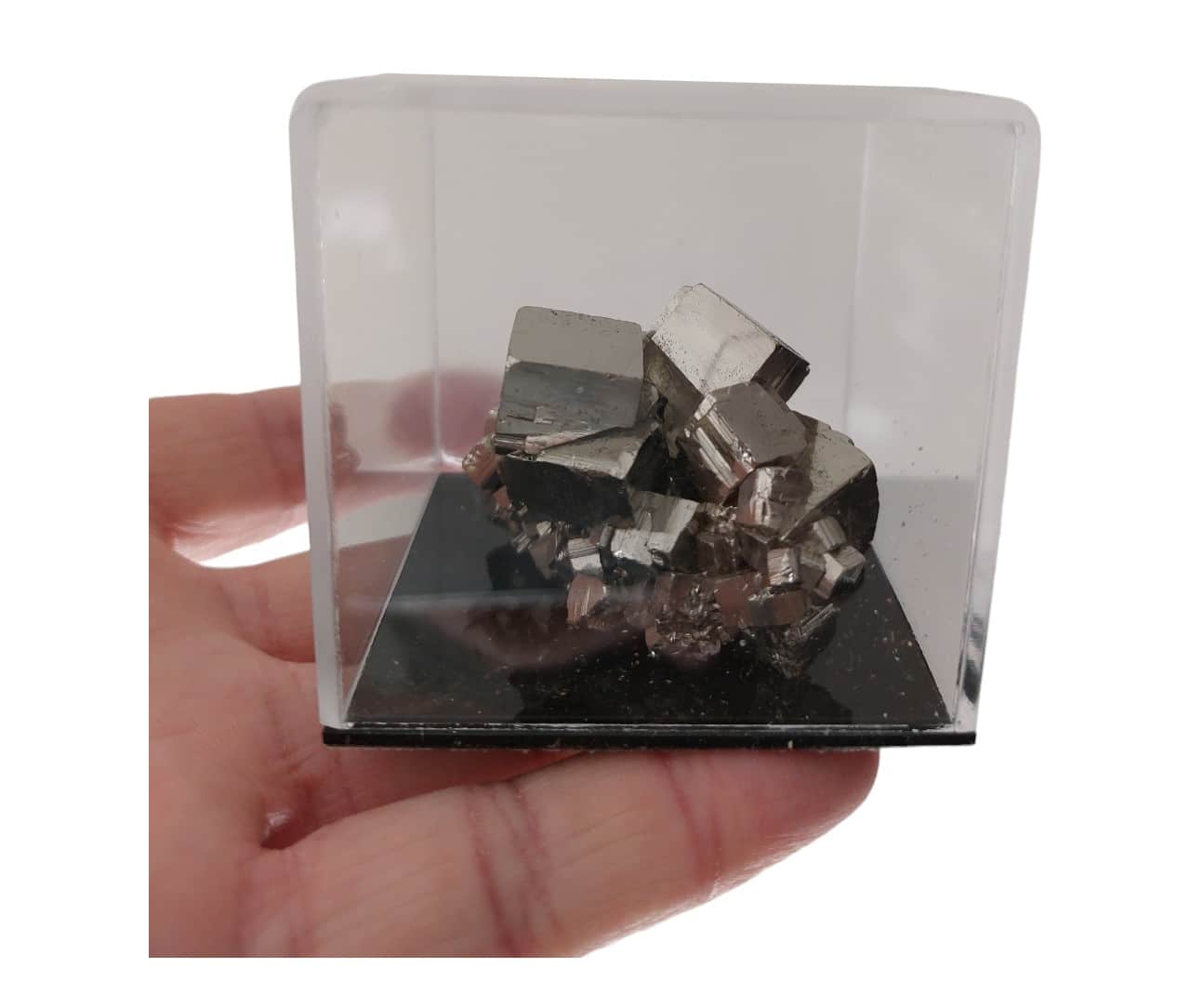
Pyrite, also known as iron pyrite, is a mineral with the chemical formula FeS2, or iron disulfide. This mineral is an important source of iron and sulfur. It often crystallizes in well-formed euhedral cubes with characteristic striations and a golden sheen. It is also known as "tinsel" or "fool's gold" because it is sometimes confused with gold. The term "cat's gold" is also sometimes used incorrectly, but that actually refers to yellow mica or resin. Pyrite is common and can create the illusion of great wealth, but it is not very valuable, although it can be traded. It is found with other sulfur-rich minerals and oxides, in quartz veins, sedimentary rocks, coal seams, and as a replacement mineral in fossils. Pyrite is a disulfide with sulfur pairs of (S2)2- and Fe2+ ions in an octahedral configuration and a t2g6 low spin state. Because both ions have a closed configuration, it is a diamagnetic semiconductor. During the weathering of pyrite, iron (hydr)oxides are formed and sulfuric acid is released. This acid can react with other minerals, leading to the formation of minerals such as gypsum, alunite, and jarosite. A well-known source of pyrite is the island of Elba. The name "pyrite" derives from the ancient Indo-European word "pyr" (fire), similar to "pyrotechnics" (fireworks) or the English word "pyre" (burning pyre), because pyrite produces sparks when struck against flint or iron. Today, "flint" means something different, namely a form of SiO2. Pyrite is also known as ferrous sulfide, ferrous sulfide, and less commonly as ironblende and iron chert. In the past, pyrite was sometimes sold as imitation gold because of its golden sheen. However, this sheen changes with tilting the surface, while the sheen of gold remains the same. Pyrite is angular with sharp edges and hard, unlike gold, which is round and soft.


