
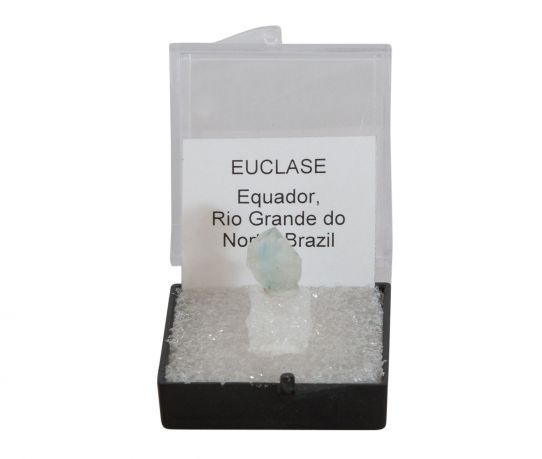
Description
The mineral euclase is a beryllium-aluminum nesosilicate with the chemical formula BeAl(SiO4)(OH). The transparent to translucent colorless, white, (light) blue, or light green euclase has a white streak color, a vitreous luster, and perfect cleavage along the crystal plane [010]. The average density is 3.04 and the hardness is 7.5. The crystal system is monoclinic, and the mineral is not radioactive. The name of the mineral euclase is derived from the Greek words eu and klasis, meaning "to break well." This name seems surprising because the mineral's hardness is 7.5. However, cleavage is not dependent on hardness. Although euclase was described as early as 1792, it has not been used as a gemstone for very long. Like other beryllium-bearing minerals, euclase is a common mineral in pegmatites, but it is also found in areas of hydrothermal activity. The type locality is the Orenburg district in the Southern Urals, Russia. It is also found in Colombia. Rich deposits of blue and green eulkaas crystals are found in Brazil. Large eulkaas crystals are also found in Zimbabwe, Uganda, Congo, South Africa, Norway, and Austria.


