
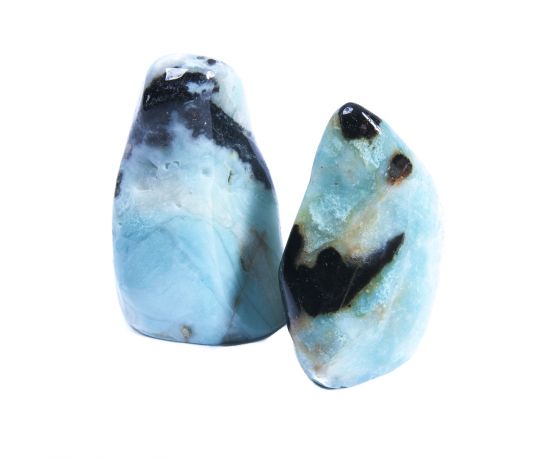
Description
Tourmaline (quartz) is a group of minerals, all cyclosilicates. The minerals in this group share a characteristic chemical formula: AX3Y6(BO3)3 Si6O18(O, OH, F)4. The A can contain calcium or sodium. The X can be aluminum, iron, lithium, or magnesium. The Y is normally aluminum, but can also be chromium or iron. Some potassium can exist in the A position, manganese can be in the X, and vanadium can be found in the Y, but these elements are not commonly found in tourmaline group formulas. Tourmaline occurs in pegmatites, metamorphites, magmatites, and alluvial deposits. Although tourmaline was known in the Mediterranean region since ancient times, it was not introduced into Western Europe from Sri Lanka by the Dutch until 1703. They named the new gemstone with a Sinhalese word “Turmali,” meaning “stone of mixed colors.” Rubellites were traditionally used as gemstones – they were used by artists as talismans, believed to enhance their creative powers. Tourmalines have certain unique properties. They are piezoelectric, meaning that when a crystal is heated or compressed, different electrical charges are formed at both ends of the crystal. This creates an electrical potential. When an external electrical potential is applied to the crystal, it vibrates. The minerals are pleochroic, meaning that the crystal appears darker in color when viewed along its longest axis than when viewed perpendicular to that axis. The four best-known and most common tourmaline minerals have varying colors and transparencies. Elbaite is transparent and a valuable gemstone. Schorl, rich in iron, is the most common mineral in the tourmaline group and is black and opaque. It is primarily formed in pegmatites, the outermost, slowly cooling gangues of magma. The two other frequently encountered tourmalines are dravite and uvite. Dravite is typically translucent brown and can grow very large. Uvite is green translucent to opaque. Tourmaline occurs in the sand fraction of Dutch Quaternary river sediments. It is a characteristic component of Meuse sands, among other things. In the heavy mineral analysis conducted in the Netherlands by the National Geological Survey during the second half of the twentieth century, the mineral is classified in the so-called stable group
Gemstone therapy Black tourmaline
Amazonite, sometimes also called Amazon stone, is a green variety of microcline feldspar. The name comes from the Amazon River, from which a certain type of green stone was formerly mined, but it is doubtful whether green feldspar also occurs in the Amazon region. Amazonite is only found in limited quantities. It was previously mined almost exclusively near the Russian town of Miass in the Ilmen Mountains of the Southern Urals, where it occurs in granitic rocks. More recently, crystals have also been found in Pikes Peak, Colorado, where it occurs in complexes with smoky quartz, orthoclase, and albite in rough granite or pegmatite. Several other locations in the United States, including Crystal Peak in the same Colorado, also contain amazonite deposits, and amazonite has also been found in pegmatite deposits in Madagascar. Because of the bright green color the mineral can acquire through polishing, amazonite is sometimes cut into pieces and used as a gemstone, although it can easily fracture. The origin of amazonite's green color has long been a matter of speculation. Many believed the color was caused by copper, as copper deposits often have blue and green hues. However, recent studies indicate that the blue-green color is the result of small amounts of lead and water in the feldspar (Hoffmeister and Rossman, 1985).


