
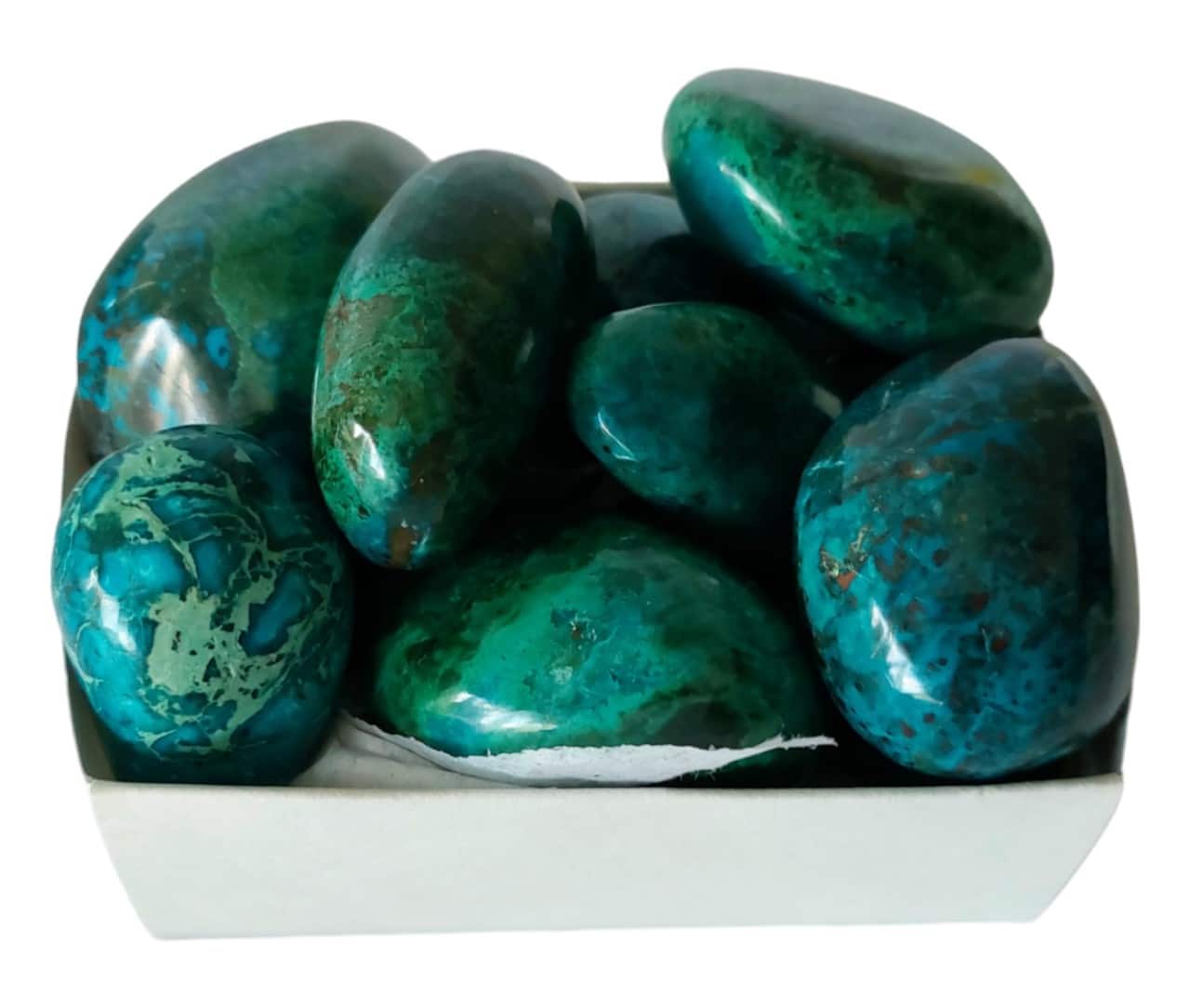
Description
The mineral chrysocolla is a hydrated copper-aluminum silicate with the chemical formula (Cu,Al)2H2Si2O5(OH)4·n(H2O). The mineral belongs to the cyclosilicates. Translucent to opaque green, blue, blue-green, or brown, chrysocolla has a dull to vitreous luster, a light green streak color, and is non-cleavage-resistant. Chrysocolla has an average density of 2.15 and a hardness of 2.5 to 3.5. The crystal system is orthorhombic, and the mineral is not radioactive. Similar minerals include dioptase, shattuckite, and turquoise. The name chrysocolla is derived from the Greek words chrysos ("gold") and kolla ("glue"). This name was given because the mineral was used to solder gold. Chrysocolla is a fairly common mineral that occurs primarily as an accompanying mineral of copper ores. The type locality is Nizhne-Tagilsk in the Urals, Russia. Significant concentrations are found in the United States, primarily in New Mexico, Nevada, Arizona, Idaho, and California. This mineral also occurs in Mexico, Chile, Peru, and Canada. Very fine stones come from Israel, South Africa, Congo, Zimbabwe, Russia, Kazakhstan, Moldova, Germany, England, Romania, and France. Eilat stone is an intergrowth of chrysocolla with turquoise and malachite, found near Eilat in Israel. Chrysocol quartz is an intergrowth of chrysocolla with quartz.


